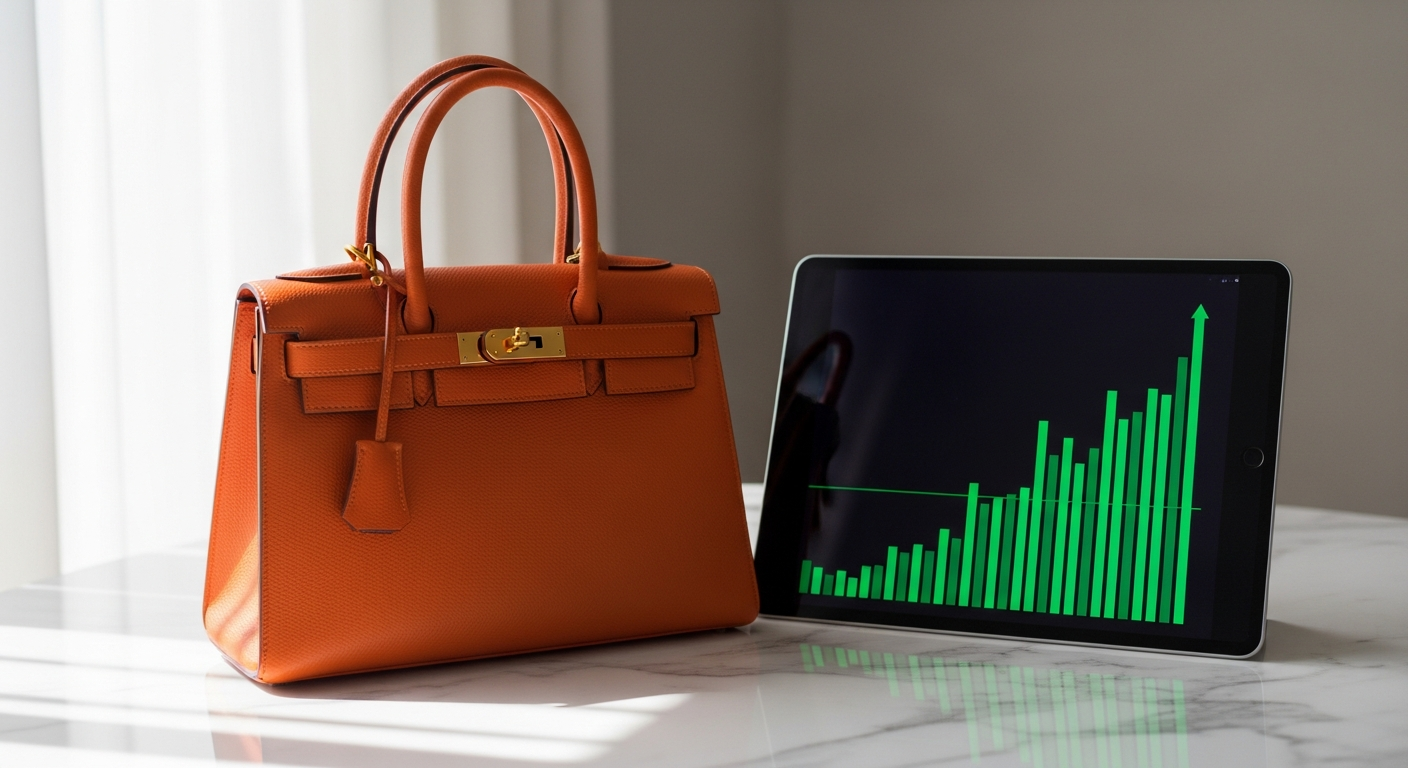
In 2016, a study by Baghunter made headlines claiming that Hermès Birkin bags had outperformed both the S&P 500 and gold over the previous 35 years, delivering an average annual return of 14.2%. The financial press went wild. "Forget stocks — buy handbags!" became a meme in wealth management circles.
But was it true? And more importantly — is it still true in 2026? The luxury handbag resale market has exploded in the last five years, driven by platforms like Vestiaire Collective, The RealReal, and Rebag. Hermès Birkins in particular have become a genuine alternative asset class, with some configurations appreciating faster than blue-chip stocks.
Let's look at the actual data — no hype, no dealer spin — and figure out whether a Birkin really belongs in your portfolio.
The Numbers: Birkin vs. S&P 500
First, the headline comparison that everyone loves to cite:
S&P 500 (1981–2025): Average annual return of approximately 10.5%, including dividends. A $10,000 investment in 1981 would be worth roughly $1.1 million today.
Hermès Birkin 35 (1981–2025): Average annual appreciation of approximately 14%, based on auction data and resale platform pricing. A Birkin purchased for $2,000 in 1984 (the first year of production) would be worth $15,000–$25,000 today in standard leather, or significantly more in exotic skins.
On pure percentage returns, the Birkin wins. But there are critical asterisks that the "buy Birkins, not stocks" crowd conveniently ignores:
No dividends. The S&P 500 pays dividends that compound. Your Birkin pays nothing while sitting in your closet. The total return gap narrows significantly when you include dividend reinvestment.
Survivorship bias. The Birkin return data only tracks bags that survived in good condition and were eventually resold. Bags that were damaged, lost, or worn to pieces don't show up in the data. The S&P 500 data includes every company, even the ones that went to zero.
Liquidity. You can sell S&P 500 shares in seconds for the exact market price. Selling a Birkin takes days to weeks and involves consignment fees of 15-30%, authentication costs, and shipping risk. Your "14% return" loses 3-5 percentage points to transaction friction.
Storage and insurance. A $20,000 Birkin needs proper storage (climate-controlled, dust-bagged) and insurance ($200-400/year). Stocks sit in a brokerage account for free.
Which Birkins Actually Appreciate
Not all Birkins are created equal. The 14% headline number is heavily skewed by outlier configurations that have seen extraordinary appreciation. The average Birkin buyer's actual experience is more modest.
Exotic skins (Himalaya, crocodile, ostrich): These are the superstars. A Himalaya Birkin 30 — white Niloticus crocodile with palladium hardware — has appreciated from roughly $80,000 at retail to $300,000-$500,000 at auction. Christie's sold one for $437,330 in 2022, a record at the time. These bags are essentially wearable art with single-digit annual production numbers.
Classic leather, neutral colors (Gold, Etoupe, Black, Etain): The bread and butter of Birkin investing. A Birkin 25 in Togo leather with gold hardware retails for approximately $11,400 and resells for $15,000-$20,000 — a 30-75% premium. These appreciate 5-8% annually if kept in excellent condition with box and receipt.
Trendy colors and seasonal editions: Highly variable. Some limited colorways spike in value initially then fade. Rose Sakura was a phenomenon that has since cooled. Vert Cypress is hot right now but may not hold. These are the riskiest configurations from an investment perspective.
Larger sizes (40, 45, 50 HAC): Actually depreciating in many cases. Fashion has moved toward smaller bags, and the Birkin 40 — once the standard — now trades at or below retail for common leathers. Size matters, and smaller is better for returns.
The Real Hermès Strategy
Here's what the data actually tells serious investors:
The bag itself isn't the whole investment. The relationship is. Getting offered a Birkin at retail from Hermès requires building a purchase history with your local boutique — typically $10,000-$30,000 in other Hermès products (scarves, ready-to-wear, home goods) before you're "offered" your first bag. This is Hermès' infamous but unwritten spend-to-get ratio.
So the true "cost" of a $11,400 Birkin 25 is really $25,000-$40,000 when you include the prerequisite purchases. Suddenly that 30-75% resale premium over retail doesn't look as impressive — you might be breaking even on total Hermès spend.
The secondary market play is different. Buying pre-owned from authenticated resellers eliminates the spending game. You pay market price — currently $15,000-$20,000 for a Birkin 25 in standard leather — and your appreciation starts from there. Less dramatic margins, but no hidden costs.
The real money is in exotics and limited editions. If you can access exotic Birkins at retail ($30,000-$80,000 depending on skin), the secondary market premium is 2-5x. But access to exotics requires years of relationship building and six-figure annual spend with Hermès. This is a rich-get-richer game.
The Birkin Market in 2026
The Birkin resale market has evolved significantly in the past two years:
Authentication technology has improved. AI-powered services like Entrupy have made counterfeit Birkins much harder to sell, which has increased trust in the secondary market and supported prices. Buyers are more confident, which means more transactions and better price discovery.
Hermès keeps raising retail prices. Annual retail price increases of 5-7% create a rising floor for the secondary market. Every retail price hike makes existing pre-owned bags relatively more affordable, which drives demand.
Younger buyers are entering. The average Birkin buyer age has dropped from 50s to 30s-40s, driven by social media visibility and the perception of Birkins as "the ultimate flex." This expanding buyer pool supports long-term demand.
The Birkin 25 has become king. The smaller size fits the current fashion aesthetic and commands the highest premiums. If you're buying one bag, buy the 25.
So Should You Buy a Birkin Instead of Index Funds?
No. And anyone telling you otherwise is selling something.
Here's the honest framework:
If you love Hermès and will carry the bag: Buy it. The combination of personal enjoyment and value retention makes it one of the few luxury purchases that doesn't feel like pure consumption. You'll use it, love it, and sell it in five years for roughly what you paid (or more). That's a cost-of-ownership near zero — better than any car, most jewelry, and virtually all fashion.
If you're buying purely as an investment: The risk-adjusted returns don't compete with a diversified stock portfolio. Transaction costs eat 15-30% on every sale. Liquidity is poor. Storage and insurance add ongoing costs. And the market is subject to fashion risk — what's desirable today may not be in ten years.
If you're wealthy and diversifying: Allocating 2-5% of your portfolio to tangible luxury assets (watches, bags, jewelry, wine) is a legitimate diversification strategy. Birkins have low correlation with equity markets and provide a hedge against currency devaluation. In this context, a small Birkin allocation makes sense — not as a primary investment, but as one component of a broader alternative asset strategy.
The bottom line: A Birkin is a better store of value than almost any other fashion purchase. But it's not a replacement for equities, real estate, or other productive assets. It's a luxury item that happens to hold value. That's remarkable — but it's not the same as an investment.
Track Luxury Asset Values — Handbags Coming Soon
LuxMetrix currently tracks 16 luxury watches with transparent, data-driven valuations. Handbag tracking — including Hermès Birkin, Kelly, and Chanel Classic Flap — is coming in Q2 2026. We'll bring the same rigorous methodology to handbags: real marketplace data, auction results, outlier filtering, and daily fair market values.
Become a Founding Member — the first 1,000 members receive complimentary Vault access for 12 months ($1,188 value). Be the first to access handbag valuations when they launch. Track your entire luxury collection — watches, bags, jewelry, and more — in one place.
LuxMetrix provides fair market value estimates based on publicly available data. These are not financial recommendations or appraisals. Always do your own research before making investment decisions.