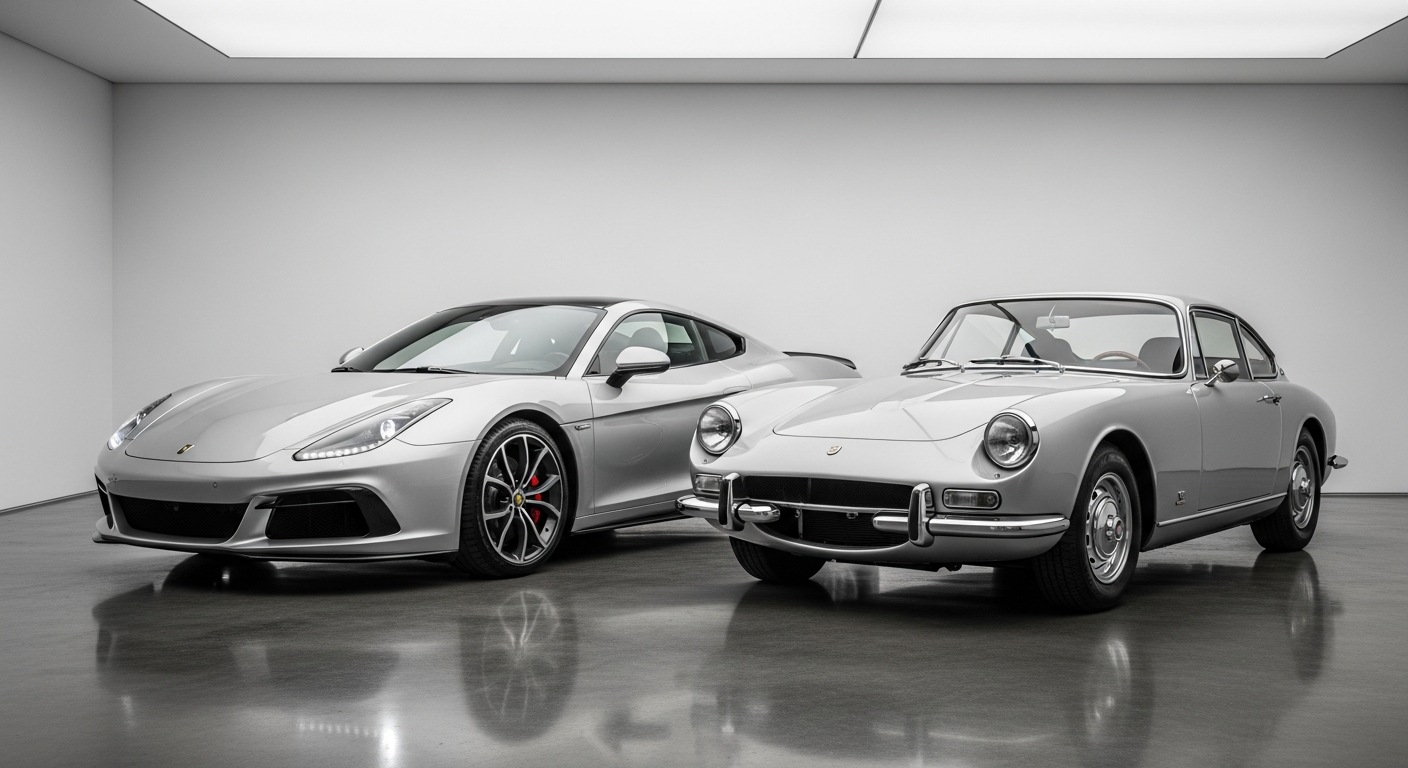
Porsche has built a reputation for making sports cars that are simultaneously daily-drivable and track-capable. But two models stand apart as the brand's most collectible offerings: the 911 GT3 and the legendary Carrera GT. One is a naturally aspirated track weapon you can buy new (if your dealer likes you). The other is a mid-engine V10 monster that has already cemented its status as one of the greatest driver's cars ever made.
At LuxMetrix, we track market data across luxury assets to separate hype from real value. Here's our data-driven buyer's guide to the two most collectible modern Porsches.
Porsche 911 GT3 (992 Generation)
Fair Market Value: $210,000 – $280,000
The 992-generation GT3 might be the best naturally aspirated sports car ever made. Its 4.0-liter flat-six revs to 9,000 RPM and produces 502 hp without a single turbocharger. In an era where every manufacturer is downsizing and turbocharging, Porsche's commitment to a high-revving naturally aspirated engine in the GT3 is both an engineering statement and a collector's hedge against an electrified future.
Current market pricing (2022–2025 models):
- GT3 (PDK): $210,000–$240,000. The PDK is faster on track and more popular with pure performance buyers.
- GT3 (6-speed manual): $235,000–$270,000. The manual commands a 10–15% premium. Collectors prize the engagement factor and the manual's likely better long-term appreciation.
- GT3 Touring: $240,000–$280,000. Wingless elegance. The Touring deletes the fixed rear wing for a subtle ducktail spoiler, creating a GT3 that looks like a standard Carrera from 20 feet away. Stealth wealth at its finest.
MSRP was $169,700 base, but allocation markups pushed real transaction prices to $200,000–$250,000+ at launch. The secondary market has now settled into a range that reflects genuine demand rather than allocation scarcity.
GT3 RS: The Track Weapon
Fair Market Value: $290,000 – $380,000
The 992 GT3 RS takes everything about the GT3 and turns it to eleven. The same 4.0-liter flat-six gets bumped to 518 hp, but the real story is the aerodynamics: the RS generates more downforce than a 991-generation GT2 RS. It's a race car with license plates, a street-legal Cup car disguised as a production Porsche.
Current market pricing:
- Standard spec: $290,000–$340,000
- Weissach Package: $340,000–$380,000. Carbon fiber wheels, titanium roll bar, magnesium roof — roughly 30 lbs saved. The Weissach Package consistently commands a $40,000–$60,000 premium on the secondary market.
MSRP was $223,800 ($241,300 with Weissach). Like the GT3, real transaction prices were significantly higher due to allocation. The RS is PDK-only — Porsche determined the manual couldn't handle the power delivery characteristics at the limit.
Value outlook: The GT3 RS will appreciate as the last naturally aspirated, combustion-only GT RS that Porsche is likely to produce. The next generation will almost certainly be hybridized. That "last of its kind" narrative is the same force that drove 997 GT3 RS 4.0 values from $250K to $800K+.
Porsche Carrera GT
Fair Market Value: $1.8M – $2.5M
The Carrera GT occupies a unique position in the collector car market. Built from 2004 to 2007, just 1,270 were produced — each powered by a 5.7-liter V10 derived from a cancelled Le Mans racing program. The engine revs to 8,400 RPM, produces 603 hp, and makes a sound that no other production car can replicate. It's mated to a 6-speed manual with the most notoriously difficult clutch in automotive history — a wooden flywheel and ceramic composite clutch with almost zero slip.
The Carrera GT is not an easy car to drive. It's light (2,755 lbs), powerful, mid-engined, and has no electronic nannies to save you. This uncompromising character is precisely why collectors worship it — and why values have climbed relentlessly.
Price history:
- 2006 (new): $448,000 MSRP
- 2010: $350,000–$400,000 (post-recession dip below MSRP)
- 2015: $700,000–$900,000
- 2020: $1.0M–$1.4M
- 2026: $1.8M–$2.5M
That's roughly 5x appreciation from MSRP — and the curve shows no sign of flattening. The Carrera GT has outperformed the S&P 500, real estate, and most alternative assets over any comparable period.
What Makes These Porsches Collectible
Naturally aspirated engines. Both the GT3's flat-six and the Carrera GT's V10 are naturally aspirated. In 2026, this is a dying breed. Turbocharging, hybridization, and electrification are the future — which means high-revving NA engines become more precious with each model year that passes. Collectors are paying a "last of the analog" premium that will only grow.
Manual transmissions. The GT3 offers a 6-speed manual option. The Carrera GT is manual-only. As dual-clutch and automatic transmissions dominate new production, the manual gearbox becomes a collector differentiator. Data consistently shows manual variants trading at 10–25% premiums over their automatic equivalents across all Porsche GT models.
Porsche's motorsport DNA. Unlike some manufacturers where the "GT" badge is marketing, Porsche's GT division (led by Andreas Preuninger) builds genuine race-derived road cars. The GT3 shares its engine architecture with the 911 GT3 Cup race car. The Carrera GT's V10 was literally intended for Le Mans. This authenticity matters to collectors.
Usability. Porsche GT cars can be driven regularly. You can take a GT3 to the grocery store, drive a Carrera GT to dinner, and track either one on Sunday. This dual-purpose nature broadens the buyer pool beyond pure investors to include driving enthusiasts — creating deeper, more resilient demand.
Buying Guide: What to Look For
GT3 (992):
- Best spec for value: Manual transmission, Touring or standard body, in a classic Porsche color (GT Silver, Racing Yellow, Shark Blue, Guards Red). Avoid heavily optioned PTS (Paint to Sample) cars unless the color is genuinely desirable — some PTS colors actually hurt resale.
- Red flags: Track-abused cars with no maintenance records. Check for stone chips on the front splitter, curbed wheels, and uneven tire wear. A pre-purchase inspection at a Porsche specialist is non-negotiable.
- Documentation: Original window sticker, complete service history, and any Porsche Classic documentation add real value. The GT3 market is mature enough that buyers expect full paper trails.
Carrera GT:
- Best spec for value: GT Silver Metallic is the most iconic color and commands the highest premiums. Fayence Yellow and Basalt Black are also strong. The interior should be full leather — avoid cars where previous owners "upgraded" to aftermarket components.
- The clutch: The ceramic composite clutch is the Carrera GT's Achilles heel. Replacement costs $20,000–$30,000 and the clutch is notoriously fragile in stop-and-go traffic. Check clutch wear indicators and factor replacement into your purchase price if the car has over 15,000 miles.
- Service history: The Carrera GT requires specialist maintenance. Look for cars serviced at authorized Porsche Classic centers or recognized independents like Callas Rennsport, Lüfteknic, or GMG Racing. Avoid cars with gaps in service records — at $2M+, there's no excuse for incomplete documentation.
- Sealed engine: The V10 is essentially maintenance-free if properly cared for, but oil changes must be done on schedule. Ask for oil analysis records if available — they can reveal bearing wear or contamination before it becomes catastrophic.
GT3 vs. Carrera GT: Which to Buy?
These are fundamentally different propositions:
Buy the GT3 if: You want a car you'll actually drive 5,000+ miles a year. You want the best naturally aspirated sports car in current production. You're comfortable spending $210,000–$280,000 and expect modest appreciation (5–10% annually) as the model ages out of production.
Buy the Carrera GT if: You want a blue-chip collector car that doubles as one of the most rewarding driving experiences on earth. You have the budget for a $2M+ purchase plus $25,000–$40,000 in annual maintenance and storage. You're comfortable with a car that demands respect every time you drive it — the Carrera GT will punish lazy inputs.
The smart play for most collectors: Buy the GT3 now, drive it hard, and let it appreciate while you enjoy it. Use the returns to fund a Carrera GT purchase in 3–5 years. The GT3's low running costs and everyday usability make it the better entry point into Porsche collecting.
Track Collector Car Values on LuxMetrix
LuxMetrix is building real-time pricing intelligence for luxury assets. Our collector car index — covering Porsche, Ferrari, Lamborghini, and Mercedes-Benz — launches in 2026 with the same data-driven methodology we use for watches: aggregated sales data, outlier filtering, and transparent fair market values.
Become a Founding Member — the first 1,000 members receive complimentary Vault access for 12 months ($1,188 value). Be the first to access collector car valuations when they launch.
LuxMetrix provides fair market value estimates based on publicly available data. These are not financial recommendations or appraisals. Always do your own research before making purchasing decisions.