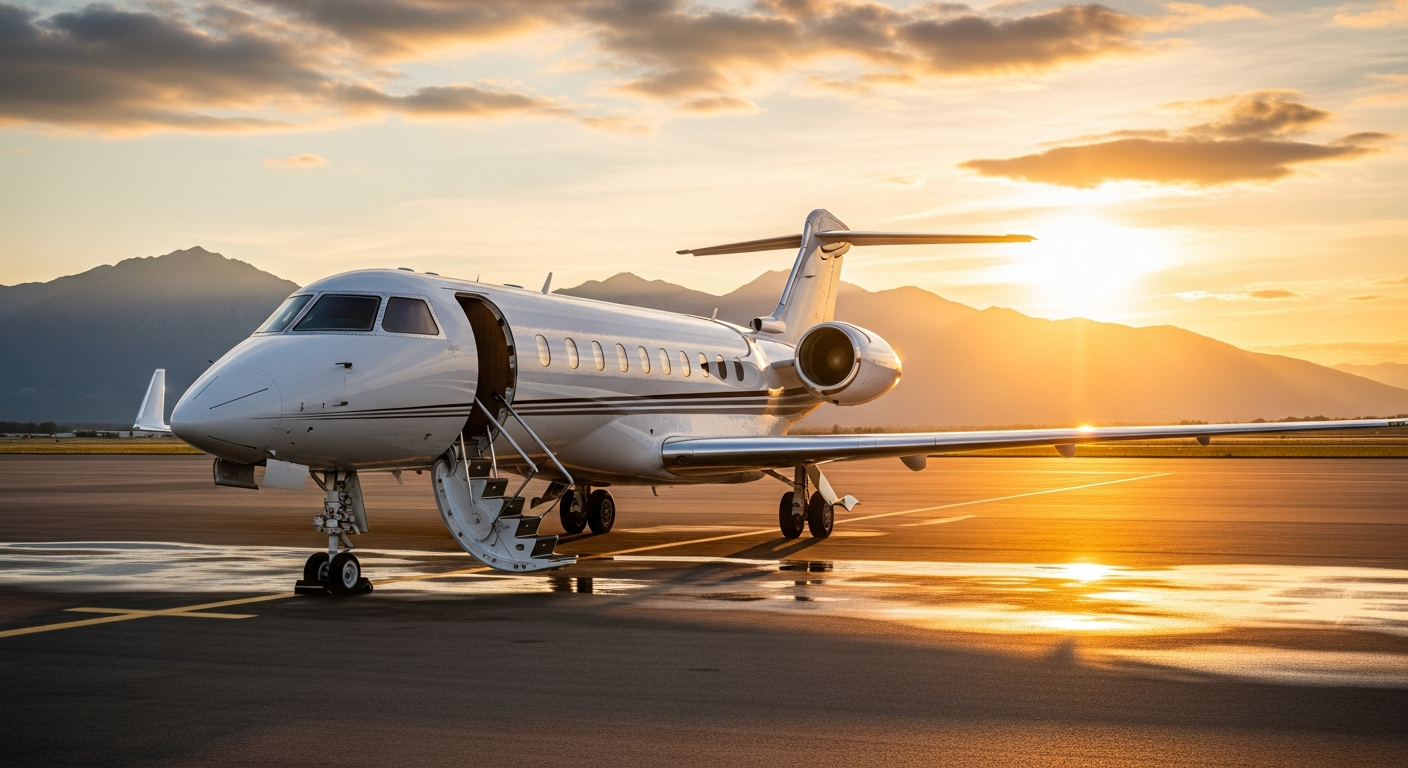
Private aviation is having a moment. Post-pandemic demand permanently shifted the market — charter hours are up 30% from 2019 levels, fractional programs have waitlists, and pre-owned aircraft prices remain elevated despite production ramping up. But the single most common question we hear from high-net-worth individuals exploring private aviation is deceptively simple: how much does it actually cost?
The answer is: it depends enormously on how you fly. At LuxMetrix, we break down every price point — from light jets to ultra-long-range flagships — so you can make an informed decision with real numbers, not marketing brochures.
The Four Ways to Fly Private
Before we talk numbers, you need to understand the four distinct models. Each has a fundamentally different cost structure:
1. On-Demand Charter: You book a specific flight. Pay per trip, no commitment. Most flexible, highest per-hour cost.
2. Jet Card / Membership: You prepay 25–50 hours of flight time at a fixed hourly rate. Guaranteed availability with 24–48 hour notice. Middle ground between charter and ownership.
3. Fractional Ownership: You buy a share (typically 1/16 to 1/4) of a specific aircraft. You own equity, pay monthly management fees, and pay occupied hourly rates when you fly. Real ownership with shared costs.
4. Whole Aircraft Ownership: You buy the plane outright. Maximum control and availability. Highest fixed costs — you pay whether you fly or not.
The right model depends on how many hours you fly annually. Under 50 hours: charter or jet card. 50–200 hours: fractional. Over 200 hours: whole ownership starts to make economic sense.
Light Jets: The Entry Point
4–7 passengers | 1,500–2,000 nm range
Light jets are the most accessible tier of private aviation. They're ideal for regional flights under 3 hours — think New York to Miami, LA to Vegas, or London to Nice.
Key models and 2026 pricing:
- HondaJet Elite S: $6.0M new. The most fuel-efficient light jet in production. Seats 5–6, range 1,547 nm. Operating cost ~$2,100/hr.
- Embraer Phenom 300E: $10.5M new. Best-selling light jet for 12 consecutive years. Seats 7–8, range 2,010 nm. Operating cost ~$2,800/hr.
- Cessna Citation CJ4 Gen2: $9.9M new. Single-pilot certified, excellent for owner-operators. Range 2,165 nm. Operating cost ~$2,600/hr.
Charter rate: $4,500–$7,500/hr (empty legs can discount 30–50%)
Jet card rate: $6,000–$9,500/hr (fixed, all-in pricing)
Annual ownership cost (200 hrs/yr): $800,000–$1.2M all-in (crew, maintenance, hangar, insurance, fuel)
Midsize Jets: The Sweet Spot
7–9 passengers | 3,000–3,500 nm range
Midsize jets are where private aviation gets serious. Stand-up cabins, full lavatories, coast-to-coast range, and enough cabin space for productive work or comfortable sleep. This is the category most executives and entrepreneurs fly.
Key models and 2026 pricing:
- Cessna Citation Latitude: $18.5M new. Flat-floor cabin, seats 9. Range 2,700 nm. Operating cost ~$3,400/hr.
- Embraer Praetor 500: $17.0M new. Best-in-class range for a midsize (3,340 nm). Fly-by-wire controls. Operating cost ~$3,600/hr.
- Bombardier Challenger 350: $27.0M new. The gold standard of the midsize category. Widest cabin, smooth ride, 3,200 nm range. Operating cost ~$3,900/hr.
Charter rate: $7,500–$12,000/hr
Jet card rate: $9,500–$14,000/hr
Annual ownership cost (250 hrs/yr): $1.5M–$2.2M all-in
Large-Cabin & Ultra-Long-Range: The Flagships
12–19 passengers | 5,000–7,500+ nm range
This is where private aviation becomes a true lifestyle platform. Ultra-long-range jets fly nonstop between any two major cities on earth — New York to Tokyo, London to Singapore, Dubai to São Paulo. The cabins rival luxury hotel suites.
Key models and 2026 pricing:
- Gulfstream G650ER: $71.5M new. The defining ultra-long-range jet. Range 7,500 nm (14 hours nonstop). Seats 13–19. Operating cost ~$6,500/hr.
- Bombardier Global 7500: $75.0M new. Longest-range purpose-built business jet (7,700 nm). Four living zones, full kitchen. Operating cost ~$7,200/hr.
- Dassault Falcon 10X: $75.0M new (deliveries starting 2026). Widest cabin in business aviation. Range 7,500 nm. The new benchmark.
- Gulfstream G800: $72.5M new. Gulfstream's latest ultra-long-range, 8,000 nm range — the longest in the industry. Operating cost ~$6,800/hr.
Charter rate: $12,000–$18,000/hr
Jet card rate: $15,000–$22,000/hr
Annual ownership cost (300 hrs/yr): $3.5M–$5.5M all-in
The Hidden Costs Nobody Talks About
The purchase price is just the beginning. Here's what catches first-time buyers off guard:
Crew: Two pilots minimum for most jets. Expect $350,000–$600,000/year fully loaded (salary, benefits, training, travel expenses). Many owners also employ a full-time flight attendant ($80,000–$120,000/year).
Hangar: $50,000–$300,000/year depending on location. Teterboro and Van Nuys are the most expensive. Smaller regional airports can be surprisingly affordable.
Insurance: $50,000–$250,000/year depending on aircraft value and pilot experience. Hull and liability are both required.
Maintenance reserves: Budget $500–$1,500 per flight hour for scheduled and unscheduled maintenance. Major inspections (every 5,000–10,000 hours or 10–12 years) can cost $500,000–$2M+ for large-cabin jets.
Depreciation: Most jets depreciate 5–10% annually for the first decade. A $70M jet might be worth $35M in 10 years. This is the single largest cost of ownership — and the one most owners underestimate. Notable exceptions: certain Gulfstream and Bombardier models have held value better post-pandemic.
Management fees: If you use a management company to handle operations (recommended for first-time owners), expect $10,000–$25,000/month.
The Break-Even Math
At what point does ownership beat chartering? Here's the simplified math:
Light jet: Ownership breaks even vs. charter at roughly 200–250 hours/year. Below that, charter or jet cards are more economical.
Midsize: Break-even at 250–350 hours/year. Fractional ownership (NetJets, Flexjet) is often the smartest play at 100–250 hours.
Ultra-long-range: Break-even at 300–400 hours/year. At $70M+ for the aircraft alone, very few individuals fly enough to justify whole ownership purely on economics. Most owners at this tier value guaranteed availability and privacy over cost optimization.
The real answer: If you're flying under 100 hours a year, you should not own a jet. Full stop. A jet card or on-demand charter gives you 90% of the experience at 30% of the cost. If you're flying 200+ hours and value having your aircraft configured exactly to your preferences, ownership starts making sense — but run the numbers with a qualified aviation advisor first.
Pre-Owned Market: Where the Value Is
The pre-owned market is where savvy buyers find real value. A 5-year-old Gulfstream G650 with 1,500 hours can be purchased for $38M–$45M — roughly 40% off its new price — with decades of useful life remaining.
Best pre-owned values in 2026:
- Bombardier Challenger 350 (2018–2020): $16M–$20M (vs. $27M new). Excellent cabin, reliable, low operating costs.
- Gulfstream G550 (2015–2018): $18M–$25M. Previous-generation flagship, still a phenomenal aircraft with 6,750 nm range.
- Embraer Praetor 600 (2020–2022): $14M–$17M (vs. $21M new). Arguably the best value in super-midsize.
Pre-owned inventory tightened significantly post-COVID but has normalized in 2025–2026. Buyers now have negotiating leverage that didn't exist 18 months ago.
Track Luxury Asset Values on LuxMetrix
LuxMetrix is building real-time pricing intelligence across every category of luxury assets — watches, handbags, cars, jets, yachts, wine, art, and properties. Our aviation index will track pre-owned aircraft values with the same transparent, data-driven methodology we use for watches.
Become a Founding Member — the first 1,000 members receive complimentary Vault access for 12 months ($1,188 value).
LuxMetrix provides fair market value estimates based on publicly available data. These are not financial recommendations or appraisals. Always do your own research before making purchasing decisions.