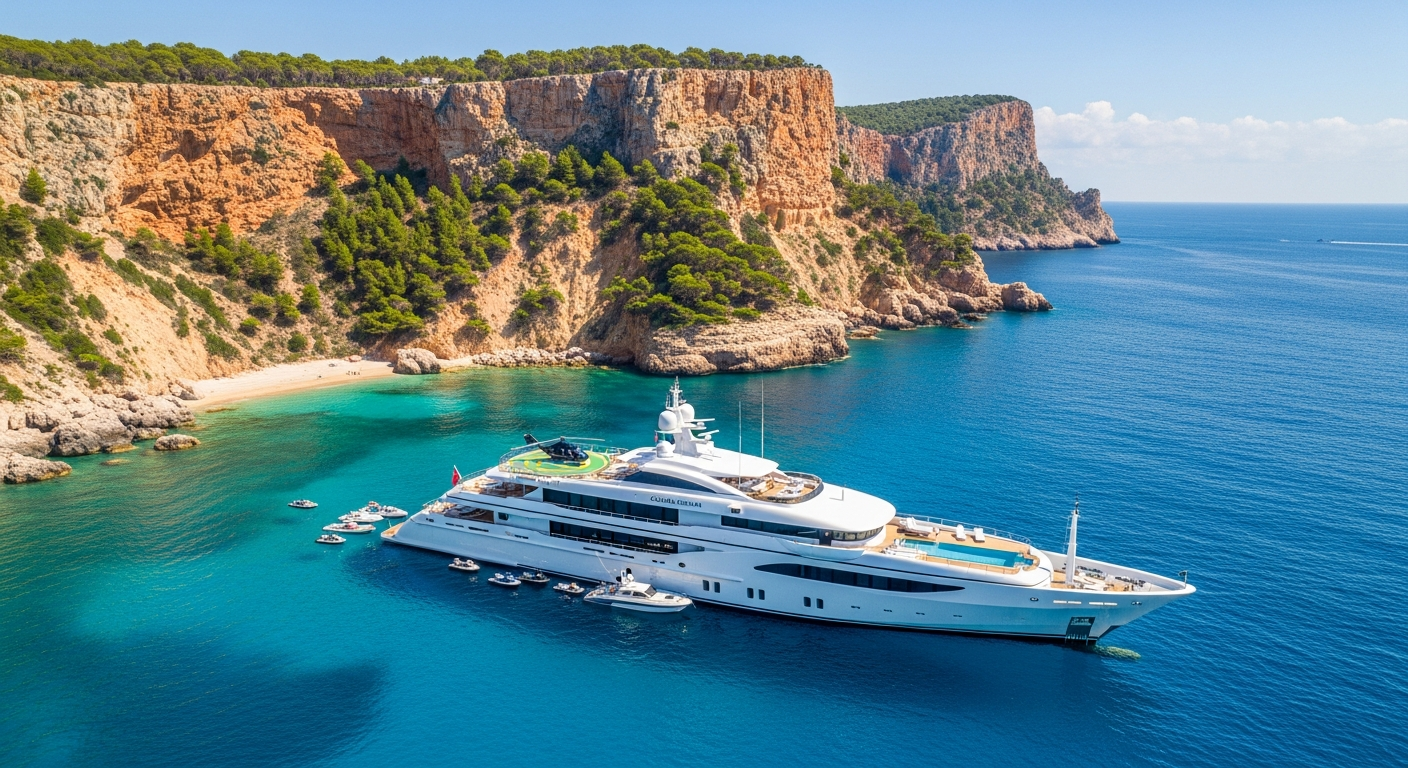
The global superyacht market has never been larger, more competitive, or more data-rich than it is in 2026. Order books at the major Northern European shipyards are full through 2028. Charter rates have stabilized at historically elevated levels. And secondary market transactions — once a whisper network of brokers and billionaires — are now tracked, benchmarked, and analyzed with the same rigor as fine watches or collector cars.
At LuxMetrix, we approach the yacht market the way we approach every luxury asset class: through real transaction data, builder track records, and transparent resale analysis. Here's where the superyacht market actually stands heading into the second half of 2026.
The Market By the Numbers
As of Q2 2026, there are roughly 5,900 superyachts (30 meters / 98 feet and above) in active service worldwide. Another 430+ are under construction or on order — a record backlog that represents over $20 billion in committed capital. The global fleet has grown approximately 4.5% per year for the past decade, with the fastest growth in the 50–80 meter segment.
Key 2026 data points:
- Average new-build price (50m+): $80M–$200M depending on builder and specification. The price per linear meter at top-tier Northern European yards has risen 30–40% since 2019.
- Average build time: 36–48 months for 60m+ custom yachts. Top slots at Lürssen, Feadship, and Oceanco are booked through 2028–2030.
- Annual operating cost: Budget 10% of replacement value per year for a fully crewed, privately operated yacht. A $100M yacht costs roughly $10M/year to run.
- Charter yield: 5–8% of replacement value for well-positioned charter yachts — not enough to offset ownership costs, but meaningful for owners who offset hard costs while retaining the asset.
Which Builders Hold Value Best
Not all superyachts are created equal on the secondary market. A 15-year-old Feadship can retain 50–65% of its original build cost. A comparable-size yacht from a lower-tier builder might fetch 25–35%. The builder's name is one of the single largest drivers of residual value.
Tier 1 — The Value-Retention Leaders:
- Feadship (Netherlands): The undisputed value-retention king. Feadships regularly sell on the secondary market at 60–75% of original build cost at 10 years of age. Every yacht is a bespoke, hand-built project — no two are identical. Waitlists run 4–6 years.
- Lürssen (Germany): The builder of record for the world's largest private yachts, including Azzam and Dilbar. Lürssen's engineering reputation and long build quality drive strong secondary market demand. Retention: 55–70% at 10 years.
- Abeking & Rasmussen (Germany): The quiet Tier 1. Smaller output than Lürssen, but comparable build quality and naval architecture pedigree. Retention: 55–65% at 10 years.
- Oceanco (Netherlands): Known for bolder exterior design and larger volumes than Feadship. Strong value retention in the 70–110m range.
Tier 2 — Strong Quality, Better Value:
- Heesen (Netherlands): High-quality semi-custom yachts in the 40–70m range. Faster delivery than Tier 1 yards, with retention around 45–55% at 10 years.
- Benetti (Italy): Italy's largest superyacht builder. Extensive line-up from 30m to 100m+. Retention varies widely by model (40–55% at 10 years).
- Sanlorenzo (Italy): Premium Italian build quality with a distinctive design language. Retention: 45–55% at 10 years.
Avoid for value retention: Lower-tier production yards, project boats from bankrupt yards, and one-off vanity projects from builders without established sales histories. These can depreciate 60–70% in the first decade.
The Size Premium: Bigger Is Better (For Resale)
Superyachts defy normal depreciation logic. In most asset classes, larger = faster depreciation. In superyachts, the opposite is often true: the largest yachts from top builders retain value best because supply is genuinely constrained.
30–45m (small superyacht): Most competitive, most supply, fastest depreciation. Retention: 35–50% at 10 years from premium builders.
50–70m (mid-size): The growing sweet spot of the market. Strong demand, limited Tier 1 supply. Retention: 50–65% at 10 years.
80m+ (large/gigayacht): Genuinely scarce. At 80+ meters from Lürssen, Feadship, or Oceanco, there are perhaps 5–8 new deliveries per year worldwide. Retention: 60–75% at 10 years. These are often upgraded and resold rather than scrapped.
The 100m+ segment is now a legitimate asset class. A 110m Lürssen delivered in 2015 might trade for $180M today against a $160M original build cost — actual appreciation, driven by long lead times at the yards and a growing pool of billionaire buyers who don't want to wait 5 years.
Charter: The Economics Most Owners Get Wrong
Charter is the most commonly cited justification for superyacht ownership: "I'll offset my costs by chartering." The data tells a more nuanced story.
Weekly charter rates in 2026:
- 40–50m yachts: $250,000–$500,000/week base rate
- 60–70m yachts: $700,000–$1,200,000/week base rate
- 80m+ yachts: $1,500,000–$3,500,000+/week base rate
On top of the base rate, charterers pay an APA (Advance Provisioning Allowance) of 25–35% of the base rate to cover fuel, food, port fees, and other variable costs. APA is reconciled at the end of the charter with any remainder refunded.
The owner's math: A well-positioned 60m yacht chartering 12–15 weeks per year can generate $9M–$15M in gross charter revenue. After broker commissions (15–20%), crew bonuses, extra maintenance wear-and-tear, and the opportunity cost of personal use weeks given up — the net-to-owner is typically $4M–$7M. That offsets roughly 50–70% of annual operating costs, not 100%.
The smart charter strategy: Treat charter income as a cost-offset, not a profit center. Yachts engineered for charter (flexible cabin configurations, robust service areas, high-volume water toys) tend to earn 20–30% more than personally-oriented yachts of similar size.
Pre-Owned: The Best Value in Yachting
The 5–10-year-old yacht market is where serious buyers find genuine value. A 2016 Feadship 80m that cost $140M to build might sell for $85M–$100M in 2026. The depreciation has already happened — the next 10 years will see much flatter value decline, and refit investments can actually add value.
Where the value is in 2026:
- 2016–2019 Benetti/Sanlorenzo 45–55m: $18M–$35M. Often 40–50% below new-build replacement cost.
- 2015–2018 Heesen 45–55m: $22M–$40M. Excellent build quality, fully refit-capable.
- 2014–2018 Feadship 60m+: $55M–$110M. The top end of the pre-owned market. These rarely stay listed long.
The refit opportunity: A well-planned $5M–$15M refit on a 10–15 year-old Feadship or Lürssen can transform a dated yacht into a fresh, charter-competitive asset at 40–50% of the total cost of new-build. For buyers with the patience and access to the right refit yards (Pendennis, Rybovich, ICON), this is the highest-ROI path into large yacht ownership.
The Trends Defining 2026
Several structural shifts are reshaping the market:
Hybrid and diesel-electric propulsion is now table stakes for new builds above 60m. Silent operation at anchor, lower emissions, and better fuel economy are driving adoption. Expect pure-diesel yachts to depreciate faster in the 2030s as hybrid becomes the baseline.
Explorer yachts (ice-capable, long-range, rugged) have moved from niche to mainstream. Damen SeaXplorer, SilverYachts, and Lürssen's expedition line-up are all seeing strong order intake.
Decarbonization regulations are tightening in the Mediterranean and Caribbean. Yachts with inefficient propulsion or non-compliant emissions will face operating restrictions by 2030. Buyers are already factoring this into bids for older vessels.
Younger buyers are entering the market. The average first-time superyacht buyer is now in their mid-40s, down from late 50s a decade ago — driven by tech, crypto, and private equity wealth. This cohort wants different things: tech integration, open-plan layouts, wellness amenities, and charter-ready configurations.
Track Luxury Asset Values on LuxMetrix
LuxMetrix is building real-time pricing intelligence across every category of luxury assets — watches, handbags, cars, jets, yachts, wine, art, and properties. Our superyacht analytics will track builder-level resale performance, charter yields, and fair market values with the same transparent methodology we use for watches.
Become a Founding Member — the first 1,000 members receive complimentary Vault access for 12 months ($1,188 value).
LuxMetrix provides fair market value estimates based on publicly available data and transaction records. These are not financial recommendations or appraisals. Always consult a qualified yacht broker, surveyor, and maritime counsel before making purchase decisions.