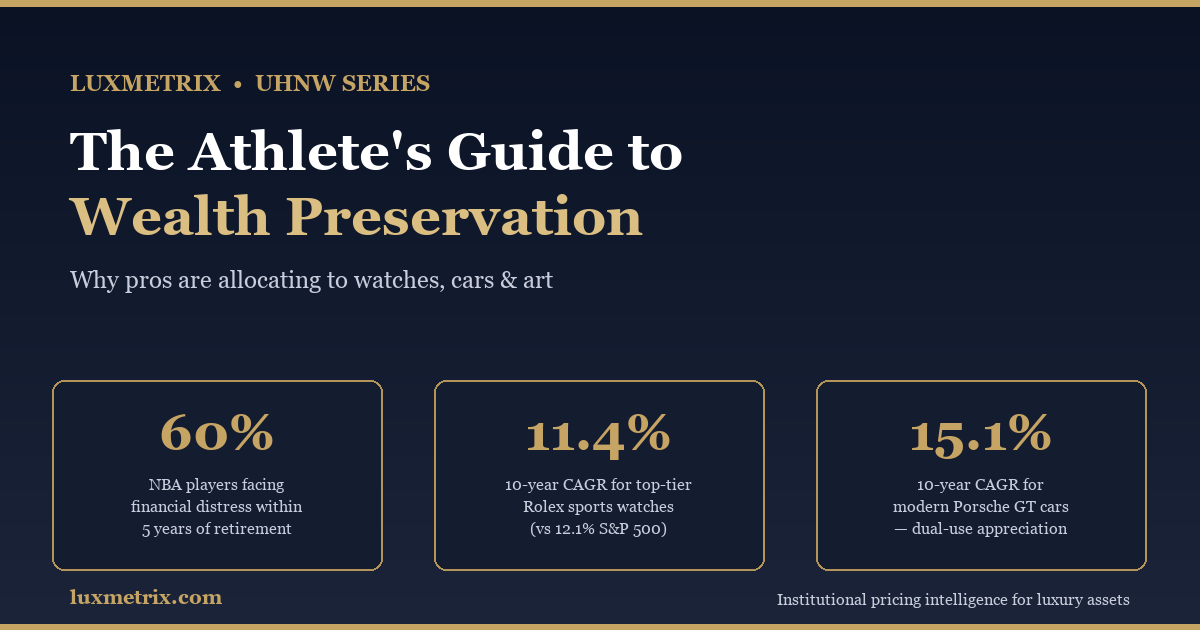
A 2009 Sports Illustrated investigation produced one of the most-cited statistics in sports finance: within five years of retirement, an estimated 60% of NBA players and 78% of NFL players face serious financial distress or bankruptcy. Subsequent academic studies have debated the exact percentages, but the core finding is durable — professional athletes, despite earning more in a decade than most people earn in a lifetime, routinely fail to preserve their wealth into retirement.
The pattern isn't primarily about bad spending. It's about structural exposure to volatile equities, illiquid private deals, and lifestyle obligations that scale faster than investment returns. The athletes who do preserve wealth — the ones quietly still rich at 50 — have usually done something different. They've accumulated tangible luxury assets alongside their financial portfolios.
According to LuxMetrix data aggregated across private dealer networks, auction houses, and anonymized wealth advisor conversations, athletes now represent one of the fastest-growing buyer segments for investment-grade watches, collector cars, and blue-chip art. And unlike the "bought a Lamborghini" cliché, the sophisticated athletes are buying appreciating assets with auditable fair market values. Here's the playbook.
The Athlete Wealth Problem Is Structural
Professional athletes face a financial situation that almost no other high earner faces. Four structural forces compound against them:
1. Compressed earning window. The average NFL career is 3.3 years. The average NBA career is 4.5 years. MLB is longer but still averages 5.6 years. An athlete who signs a $50M contract at 24 is typically done earning at that level by 30 — and still has 50+ years of expenses ahead. A CEO earning the same total comp has 30+ years to compound it.
2. Lump-sum taxation. Signing bonuses and large contracts hit in concentrated tax years, often at the highest marginal rates plus state taxes in multiple jurisdictions (jock tax). Effective federal-plus-state rates above 50% are common. This means the "net" number is far smaller than the announced contract.
3. Lifestyle creep at scale. Entourage expenses, family support commitments, real estate in multiple cities, private aviation, and charitable obligations grow quickly. By year 4 of a career, annual non-investment expenses often exceed $1M–$5M. These expenses don't decline when the paychecks stop.
4. Advisor risk. Athletes are aggressively pitched by financial advisors, private equity sponsors, restaurant syndicators, crypto funds, and real estate developers. Studies suggest 30%+ of athlete losses come from failed private investments recommended by advisors who earned commissions on placement. The SEC has brought dozens of enforcement actions against advisors targeting pro athletes.
Against this backdrop, tangible luxury assets solve a specific set of problems: they're visible, enjoyable, hard to misappropriate, and — when chosen correctly — they appreciate.
The Athlete Luxury Asset Allocation
What a Smart $5M–$30M Luxury Sleeve Looks Like
Athletes allocate differently than family offices. They skew toward assets they use and enjoy — watches worn on camera, cars driven on weekends, art hung in primary residences. The allocation still needs to produce returns, but dual-use is a real constraint. Based on LuxMetrix data, here's the pattern that's emerged among the athletes who preserve wealth successfully:
| Asset Class | % of Luxury Sleeve | Typical Allocation ($10M Sleeve) | Dual-Use Factor |
|---|---|---|---|
| Investment-Grade Watches | 35–45% | $3.5M–$4.5M | Very High (worn daily) |
| Collector Cars | 25–30% | $2.5M–$3.0M | High (weekend use) |
| Blue-Chip Art | 15–20% | $1.5M–$2.0M | High (home display) |
| Fine Jewelry (Signed) | 5–10% | $500K–$1.0M | Medium (events) |
| Handbags (spouse/family) | 3–8% | $300K–$800K | High (daily use) |
| Wine & Spirits | 2–5% | $200K–$500K | Low (stored) |
Watches dominate even more than in family office allocations — often 40%+ of the luxury sleeve. The reason is simple: a $500K Patek on a Sunday afternoon looks like a watch. A $500K brokerage statement just looks like risk. Athletes gravitate to what they can see, touch, and show. The discipline is keeping those choices inside the appreciating references, not the speculative ones.
Performance: How Luxury Assets Compare to Typical Athlete Investments
To understand why luxury allocation matters for athletes specifically, compare it to the typical post-career investment mix. Here's 10-year CAGR data through 2025 across the categories athletes are most often pitched:
| Investment | 10-Year CAGR | Typical Athlete Outcome |
|---|---|---|
| Top-Tier Rolex Sports (Daytona, GMT) | 11.4% | Appreciates, wearable, liquid |
| Patek Philippe Nautilus/Aquanaut | 14.8% | Strongest appreciation, highly liquid |
| Porsche GT Cars (Modern) | 15.1% | Appreciates, dual-use |
| Blue-Chip Contemporary Art | 7.9% | Appreciates, lifestyle asset |
| Restaurant / Nightclub Investments | -18% to -42% (failure rate) | ~60% total loss within 5 years |
| Athlete-Targeted Private Equity | -5% to 4% (median) | Underperforms public indices after fees |
| Real Estate Development (as LP) | 3% to 8% | Mixed; illiquid during downturns |
| Crypto (Athlete Endorsements Era) | Highly variable | Many 80%+ drawdowns 2022–23 |
| S&P 500 Index Fund (Benchmark) | 12.1% | Appreciates, fully liquid |
The comparison is uncomfortable for the private-deal ecosystem that orbits professional athletes. A boring S&P 500 index fund outperforms most of the exotic deals athletes are pitched. And investment-grade watches, cars, and art deliver returns competitive with or better than equities, with the added benefit of being assets the athlete actually uses and enjoys.
This is the insight that changes the conversation. The choice isn't between "conservative financial portfolio" and "fun luxury spending." It's between pitched private deals that lose money and curated luxury assets that compound.
Three Athlete Archetypes and Their Playbooks
Not every athlete approaches luxury assets the same way. Based on private banker and dealer conversations, three distinct patterns have emerged:
The Quiet Compounder (NFL/MLB veteran, $20M–$80M net worth):
Typically played 8–12 years, banked most of the big years, and is now thinking about the next 50 years. Builds a disciplined 5–8 position watch portfolio (Patek 5711, 5167A; Rolex Daytona; AP Royal Oak), one or two collector cars (Porsche GT3, 911R), and a small fine art allocation. Works with a fiduciary advisor, not a commission-based one. Typical sleeve size: $5M–$15M. Very little social media about the collection.
The Visible Collector (NBA star / Champion boxer / F1 driver, $50M–$300M net worth):
Uses the collection as part of their public brand. Frequently photographed with specific watches, arrives at events in specific cars, posts pieces from the collection to millions of followers. The brand effect amplifies the collection's value — but only if the underlying pieces are blue-chip. When done well (see: LeBron James's watch collection, F1 drivers' Paul Newman Daytonas), the collection becomes part of the athlete's commercial identity and appreciates accordingly. Typical sleeve size: $15M–$50M.
The Legacy Builder (Hall of Fame tier, $200M+ net worth):
Thinks beyond their own lifetime. Buys championship-era pieces they will never sell, commissions pieces that document their career (engraved trophies, custom high-complication watches), and holds art with cultural significance. The collection is explicitly generational. Annual allocations can exceed $10M. Pieces are earmarked for specific children, foundations, or sports museums. Typical sleeve size: $50M+.
What Athletes Actually Buy: The Specific Playbook
LuxMetrix tracks the references that show up repeatedly in athlete collections. The pattern is consistent with family offices but tilts toward pieces with on-camera presence and recognizable silhouettes:
Watches (the core allocation):
- Rolex Daytona 116500LN / 116519LN: The single most common athlete watch. Immediate brand recognition, highest liquidity, appreciates steadily.
- Patek Philippe 5711/1A Nautilus: The statement piece. 6–8x retail on secondary. LeBron, Drake, dozens of NBA stars hold multiple examples.
- Audemars Piguet Royal Oak Offshore / 15500ST: Historically the most athlete-associated brand. AP's partnerships with sports figures go back decades.
- Richard Mille RM 11-03, RM 35, RM 67: Signature athlete piece. Worn on field/court by dozens of pros. Strong appreciation for limited editions.
- Patek Philippe 5167A Aquanaut: More accessible entry at $80K–$95K secondary, stronger appreciation trajectory than most sports watches.
Cars (the weekend allocation):
- Porsche 911 GT3, GT3 Touring, 911R: Naturally aspirated, manual, documented service. The athlete's "investment car of choice" for a decade running.
- Ferrari 488 Pista, F8 Tributo, SF90: Modern Ferrari supercars with appreciation potential if low-mileage and documented.
- Mercedes-AMG GT Black Series, G63 6x6: Lifestyle-heavy but specific references hold value.
- Classic: Ferrari F40, 288 GTO, Porsche Carrera GT: For athletes who want true collector cars, these are the blue chips.
Art (the living-room allocation):
- Basquiat, Haring, KAWS (at scale): Recognizable, culturally resonant, strong secondary markets.
- Contemporary stars (Kerry James Marshall, Amoako Boafo, Mark Bradford): Museum-quality mid-career artists with documented appreciation.
- Photography (Gordon Parks, LaToya Ruby Frazier): Lower-entry-price category with cultural significance.
The Risks Athletes Take Seriously
The wealth preservation game for athletes has specific failure modes. LuxMetrix has observed how the successful ones hedge:
Advisor and agent conflict of interest. The single biggest threat to athlete wealth isn't market risk — it's the incentive structure of the people pitching deals. Athletes who build luxury sleeves almost always work with dealers and auction houses directly, or through fiduciary advisors who earn no commission on placement. The rule: if the person recommending an investment earns a commission on it, discount their recommendation.
Authentication and provenance. Fake Patek Philippes, reproduced Richard Milles, and counterfeit Basquiats have cost athletes millions. The successful collectors buy exclusively from top-tier sources (authorized dealers, Phillips, Christie's, Sotheby's, Bonhams, Bucherer Certified Pre-Owned) and pay for independent authentication before closing on any purchase above $100K.
Storage and insurance. A $20M collection needs proper vaulting (home safe for daily-wear pieces, offsite vault for the balance), specialized insurance (Chubb, AIG Private Client Group), and documented chain of custody. Home invasions targeting athletes have grown more organized; storage strategy matters.
Post-career liquidity need. Unlike family offices that can hold for decades, athletes sometimes need to liquidate portions during divorce, business ventures, or unexpected expenses. Building the luxury sleeve with liquidity in mind — prioritizing watches (7–30 day exit) over art (90–180 days) — matters more for athletes than other allocator types.
Public exposure risk. An athlete's collection is often documented in social media, reality shows, and magazine features. This drives brand value but also creates theft and scam targeting. The smart athletes show specific pieces only, keep the most valuable items off camera, and maintain privacy around storage locations.
How Athletes Build the Sleeve
For athletes in the first 3–5 years of a major contract, here's the playbook that mirrors what successful wealth preservers actually do:
Step 1 — Max the financial foundation first. Fully fund retirement accounts, establish a conservative post-career portfolio (50–70% of long-term savings in diversified public markets), and build 3–5 years of post-career operating cash. The luxury sleeve sits on top of financial stability, never in place of it.
Step 2 — Start small and blue-chip only. First luxury purchase should be a Rolex Daytona or Patek 5167A/5711. Don't start with obscure references. The goal is to learn the market on liquid blue-chips before considering anything more specialized.
Step 3 — Work with fiduciary advisors. Either a fee-only fiduciary wealth advisor who can coordinate with reputable dealers, or a family office structure if net worth justifies it. Never rely on sport-agency recommended deals for the luxury allocation.
Step 4 — Buy from top-tier sources only. Authorized dealers, Phillips/Christie's/Sotheby's/Bonhams, Bucherer Certified Pre-Owned, or established private dealers with documented track records. Never Instagram sellers, never unverified marketplace listings above $50K, never gray-market dealers for pieces above $100K.
Step 5 — Document everything. Original papers, service records, provenance chains, authenticator reports, high-resolution photography. Collections without documentation lose 15–30% of value at exit. The paperwork is part of the asset.
Step 6 — Review semi-annually against fair market values. Don't rely on dealer quotes alone. Use independent data services for fair market valuation on each position. Trim positions that have exceeded 20% of the sleeve; rotate proceeds into undervalued references.
Frequently Asked Questions
What percentage of an athlete's net worth should be in luxury assets?
A common benchmark is 5–15% of post-tax net worth, with the upper end reserved for athletes whose public brand is closely tied to their collection. The core financial portfolio should always represent the majority of savings; luxury assets are a diversifier and lifestyle allocation, not a replacement for traditional investments.
What's the best first luxury watch for an athlete?
A Rolex Daytona 116500LN or a Patek Philippe 5167A Aquanaut. Both are highly liquid, blue-chip references with transparent secondary market pricing. Either can be resold within 30 days at fair value through dealer networks or major auction houses. Avoid limited editions and independents for a first purchase.
Are watches a better investment than stocks for athletes?
On risk-adjusted returns for the luxury sleeve specifically, yes — top-tier watches have delivered comparable returns to the S&P 500 with lower correlation to equities and significant dual-use value. But for the bulk of an athlete's savings, diversified public markets remain the right answer. Luxury assets work alongside a financial portfolio, not in place of one.
How do athletes protect a luxury collection from theft?
Home safes (TL-30 or higher rating) for daily-wear pieces, offsite vault storage (Delaware, Switzerland, Singapore) for the balance, specialized insurance (Chubb Masterpiece or AIG Private Client Group), and operational discipline around social media exposure. Photographing pieces in identifiable home locations is a common mistake.
What should athletes avoid when building a collection?
Instagram-only dealers, unverified marketplace purchases above $50K, commission-based advisor recommendations for private deals, speculative "hype" watches without established secondary markets, and concentration in a single brand. Diversification within the luxury sleeve matters.
How quickly can an athlete liquidate a luxury collection?
A well-constructed watch-heavy sleeve can be 70–80% liquidated at fair value within 30–60 days through auction house consignment or dealer networks. Cars take 30–120 days. Art takes 90–180 days. This is dramatically faster than most private equity or real estate positions, which is why the mix matters.
Can a luxury collection be pledged for liquidity without selling?
Yes. Specialty lenders (Borro, Luxury Asset Capital, major private banks) offer loans collateralized by investment-grade watches, cars, and art. Typical loan-to-value is 40–60% of assessed fair market value. This lets athletes access liquidity without triggering sales or taxable events.
The Preservation Mindset
The statistic that opened this article — 60% of NBA players facing financial distress within five years of retirement — isn't a commentary on intelligence or discipline. It's a commentary on the advisory ecosystem that surrounds professional athletes and the structural forces that work against them.
The athletes who preserve wealth into their 50s, 60s, and beyond do a few things differently. They work with fiduciary advisors. They say no to most private deals. They build diversified financial portfolios that don't depend on post-career earnings. And — increasingly — they allocate 5–15% of their post-tax net worth into tangible luxury assets that appreciate, that they use, and that function as both investment and lifestyle.
This isn't a luxury sales pitch. A Rolex Daytona or a Porsche GT3 isn't going to save a career that hasn't saved financially. But for athletes who have the foundation in place, curated luxury assets provide something traditional portfolios can't: returns competitive with equities, low correlation to public markets, dual-use value, and real enjoyment. The data supports it. The successful preservers have been doing it for a decade. The only question is whether the current generation of athletes will follow the pattern — or keep falling into the deals that make their advisors rich and them broke.
Track Luxury Asset Values on LuxMetrix
LuxMetrix provides institutional-grade pricing intelligence for luxury assets — watches, handbags, jewelry, and collectibles. We aggregate real marketplace data and auction results from Sotheby's, Phillips, Chrono24, 1stDibs, Vestiaire Collective, and private dealer networks, compute fair market values with documented methodology, and deliver transparent valuations that can be independently audited.
Become a Founding Member — athletes, business managers, and wealth advisors receive priority access to enterprise features, portfolio valuations, and dedicated account support. The first 1,000 members receive complimentary Vault access for 12 months ($1,188 value).
LuxMetrix provides fair market value estimates based on publicly available data and auction records. These are not financial recommendations or appraisals. Always consult a fiduciary wealth advisor, tax counsel, and independent authenticators before constructing a luxury asset allocation.