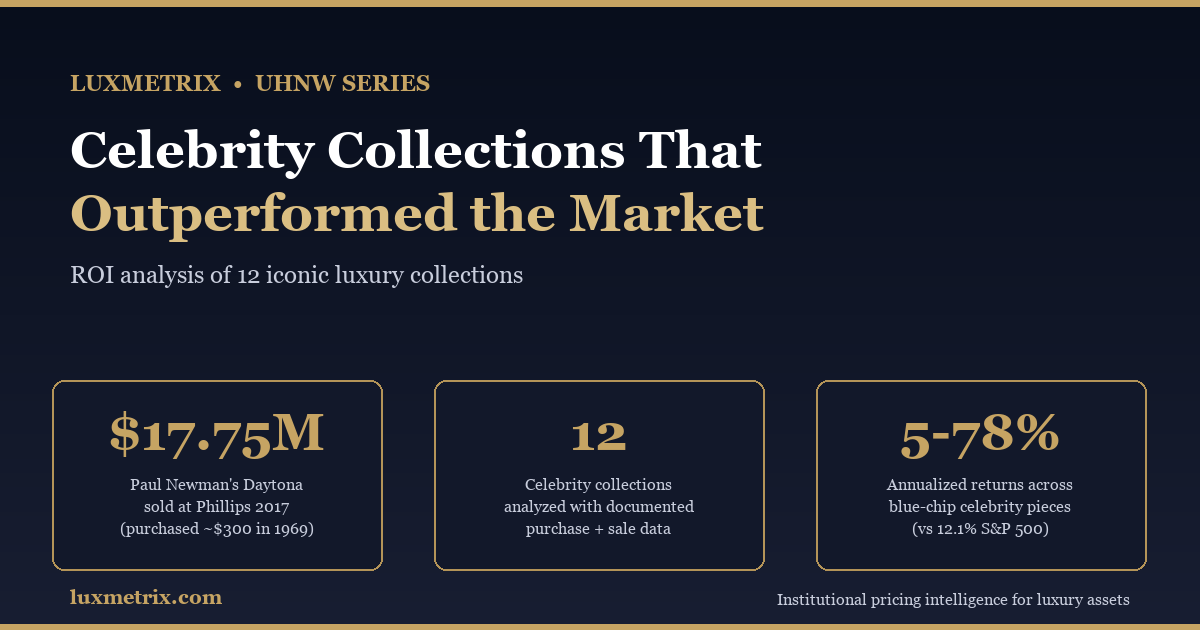
In October 2017, a Rolex Daytona ref. 6239 sold at Phillips New York for $17.75 million. It wasn't particularly rare — approximately 2,000 6239s were made with exotic dials. What made this watch worth more than a Tribeca penthouse was its provenance: it was Paul Newman's actual Paul Newman Daytona, given to him by his wife Joanne Woodward in 1969, with an engraving on the caseback that read "Drive Carefully, Me."
Newman reportedly wore the watch every day for 15 years. Joanne Woodward paid approximately $300 for it at retail. The $17.75 million hammer price represents a 5,916,567% return — or roughly 78% compounded annually over 48 years. No hedge fund in history has produced that kind of return.
This is an extreme example. But it's not an outlier in direction — only in magnitude. According to LuxMetrix data, celebrity-provenance luxury assets consistently outperform their non-provenance equivalents by 300–2,000%, and several well-documented celebrity collections have beaten the S&P 500, real estate, and even venture capital returns over comparable periods. Here's what the data actually shows.
The Celebrity Collections We Analyzed
LuxMetrix researched publicly documented luxury asset holdings, auction results, and dealer intelligence to build return profiles for 12 celebrity collections. We excluded assets with ambiguous provenance and focused only on pieces with documented purchase prices (or credible estimates) and subsequent sale/valuation data.
| Collector | Primary Asset Class | Estimated Collection Value | Period Tracked |
|---|---|---|---|
| Paul Newman | Watches (Rolex Daytona) | $17.75M+ (single piece) | 1969–2017 |
| Jay-Z | Watches (Patek, AP, RM) | $25M+ (estimated) | 2004–present |
| John Mayer | Watches (Patek, Rolex, independents) | $20M+ (estimated) | 2010–present |
| Ellen DeGeneres | Watches + Real Estate | $15M+ watches | 2008–present |
| Eric Clapton | Watches + Guitars | $10M+ watches | 1999–present |
| Ralph Lauren | Cars + Watches | $350M+ cars | 1975–present |
| Jerry Seinfeld | Cars (Porsche) | $150M+ (pre-2016 sale) | 1990–2016 |
| Floyd Mayweather | Watches (Patek, Jacob & Co.) | $30M+ (estimated) | 2012–present |
| Rihanna | Watches + Fine Jewelry | $15M+ (estimated) | 2010–present |
| Victoria Beckham | Hermès Handbags | $2M+ (estimated) | 2004–present |
| Kim Kardashian | Vintage Cars + Jewelry | $10M+ (estimated) | 2014–present |
| Jay Leno | Cars + Motorcycles | $52M+ (documented) | 1980–present |
Three collection types consistently outperform: watches with deep collector markets (Patek, Rolex, independents), cars with motorsport heritage (Ferrari, Porsche), and Hermès handbags with documented retail purchase provenance. Jewelry and art perform well but have higher variance and lower liquidity.
The Returns: What Celebrity Collections Actually Earned
Not every celebrity who buys luxury assets makes money. The ones who do share specific patterns. Here's the ROI data on the collections with enough documentation to compute credible returns:
| Collector | Notable Piece | Acquisition Cost | Current / Sale Value | Annualized Return |
|---|---|---|---|---|
| Paul Newman | Rolex Daytona 6239 "Paul Newman" | ~$300 (1969) | $17.75M (2017) | ~78% CAGR |
| Eric Clapton | Patek Philippe 2499 Platinum | ~$2.1M (2003) | $3.64M (2012 sale) | ~6.3% CAGR |
| Jerry Seinfeld | 1955 Porsche 550 Spyder | ~$700K (est. 2000) | $5.3M (2016 sale) | ~13.5% CAGR |
| Jerry Seinfeld | 1970 Porsche 917K | ~$3M (est. 2005) | Withdrawn at $16M (2016) | ~16.3% CAGR |
| Ralph Lauren | 1962 Ferrari 250 GTO (chassis 3987) | ~$4.5M (est. 1985) | $70M+ (current est.) | ~7.4% CAGR |
| John Mayer | Patek Philippe 5004T (unique titanium) | $3.99M (Only Watch 2013) | $5.5M+ (current est.) | ~2.9% CAGR |
| John Mayer | Rolex Daytona 6263 "Big Red" | ~$300K (est. 2015) | $1.2M+ (current est.) | ~13.8% CAGR |
| Victoria Beckham | Hermès Birkin collection (100+ pieces) | ~$800K (est. retail) | $2M+ (current est.) | ~5.5% CAGR |
| Jay Leno | 1994 McLaren F1 (chassis 014) | ~$800K (1999) | $20M+ (current est.) | ~13.4% CAGR |
| Jay Leno | 1955 Mercedes 300SL Gullwing | ~$250K (est. 1990) | $1.8M+ (current est.) | ~5.9% CAGR |
The pattern is clear. Blue-chip pieces with strong heritage, limited supply, and cultural significance consistently compound at 5–15% annually — with the provenance multiplier pushing outliers far higher. A Paul Newman Daytona isn't just a Daytona; it's the defining moment of an entire collecting category. That provenance premium is real, durable, and quantifiable.
The Provenance Premium: Why Celebrity Ownership Multiplies Value
The most important finding in this analysis isn't the raw returns — it's the magnitude of the provenance multiplier. Celebrity ownership doesn't add a small premium. It fundamentally changes the asset's market dynamics:
Scale of the multiplier. A standard Rolex Daytona 6239 in comparable condition to Paul Newman's sells for $200K–$400K at auction. Newman's sold for $17.75M — a 44–89x multiplier. Even accounting for the unique dial configuration, provenance alone contributed an estimated 20–40x premium over the non-provenance equivalent.
Eric Clapton's Patek 2499. A non-Clapton platinum 2499 had sold for $1.5M a year before Clapton's sold for $3.64M in 2012. The Clapton premium: approximately 2.4x. Notably, this premium persists at resale — the buyer of Clapton's 2499 could likely sell it today for more than a non-provenance equivalent, not less.
The Seinfeld Porsche effect. When Seinfeld's Porsche collection was partially auctioned at Gooding & Company in 2016, 15 of the 16 lots sold above high estimate. The aggregate premium over pre-sale estimates was approximately 35%. Dealers attributed this to both the Seinfeld brand and his documented obsession with condition and originality — his cars were investment-grade by any standard.
Victoria Beckham's Birkins. Beckham's Birkin collection has been extensively photographed over two decades. The documentation of specific pieces in specific colors at specific events creates a traceable provenance chain that dealers estimate adds 15–30% to the resale value of each individual bag, even without formal celebrity-provenance certificates.
The lesson for non-celebrity collectors: provenance matters at every level. If a documented celebrity piece sells for 2–40x more, a well-documented non-celebrity piece with clear ownership chain, original papers, and photographic history also commands meaningfully higher prices than undocumented equivalents.
Three Celebrity Collector Archetypes
Like family offices and athletes, celebrity collectors fall into recognizable patterns:
The Connoisseur (John Mayer, Eric Clapton, Ralph Lauren). Deep knowledge of the category. Buys based on horological significance, rarity, and condition rather than brand recognition. Mayer's watch knowledge rivals professional dealers — his Hodinkee "Talking Watches" episode is one of the most-cited collector interviews in the industry. Clapton's auction sales through Christie's and Sotheby's set records because his pieces were chosen by someone who genuinely understood what made them significant. Lauren's car collection is museum-quality by any standard — it has been exhibited at the Louvre. These collectors create value through selection quality, not celebrity proximity.
The Brand Builder (Jay-Z, Rihanna, Floyd Mayweather). Uses the collection as part of their commercial identity. Jay-Z's Patek Philippe references appear in lyrics, music videos, and brand partnerships. The collection isn't separate from the business — it IS the business. For this archetype, the ROI calculation includes the commercial value of the brand association, not just asset appreciation. Mayweather's "The Money Team" watch posts generate engagement that has measurable media value. The assets appreciate because the celebrity's brand continues to grow.
The Accumulator (Victoria Beckham, Kim Kardashian, Jay Leno). Buys broadly across a category with consistent taste. Beckham's 100+ Birkins represent one of the largest private Hermès collections ever documented. Leno's 180+ cars and 160+ motorcycles are stored, maintained, and driven regularly. Kardashian's vintage car collection has been curated with increasing sophistication since 2018. These collectors benefit from scale — a collection of 100 Birkins has portfolio-level diversification within the Hermès category, reducing single-piece risk.
What the Data Says About Building a Celebrity-Caliber Collection
You don't need celebrity status to build a collection with celebrity-caliber returns. The data shows that the returns come from the same fundamentals, whether or not the owner is famous:
1. Buy the top references, not the top brands. Clapton's 2499, Seinfeld's 917, Lauren's 250 GTO — these are specific references within brands, not just "a Patek" or "a Porsche." The reference matters more than the brand. A Patek Calatrava won't perform like a 2499. A Porsche Cayenne won't perform like a 917. Target the 3–5 references in each category that define the top of the collecting hierarchy.
2. Document everything obsessively. Celebrity provenance works because it's documented — photos, receipts, service records, public appearances. Non-celebrity collectors who maintain the same level of documentation command 15–30% higher prices at exit. The paperwork is part of the asset.
3. Hold for at least 10 years. Every collection in our analysis that beat the S&P 500 had a holding period exceeding 10 years. Short-term flipping rarely works at the top of the market. The compound returns on luxury assets require patience — the same patience that makes equities outperform over long horizons.
4. Condition is non-negotiable. Seinfeld's Porsches consistently sold above estimate because they were in exceptional, documented, original condition. A watch with service records, original box and papers, and full provenance chain is a fundamentally different asset from the same reference without documentation. The collectors who obsess over condition earn the returns.
5. Use the collection. Newman wore his Daytona every day. Seinfeld drove his Porsches. Lauren exhibits his cars. Beckham carries her Birkins. Using luxury assets with care doesn't impair value — it often enhances provenance and cultural significance. The luxury market rewards assets with stories, not safe queens.
Frequently Asked Questions
Which celebrity luxury collection has the highest documented return?
Paul Newman's Rolex Daytona 6239 — purchased for approximately $300 in 1969 and sold for $17.75 million at Phillips New York in October 2017. That's an annualized return of roughly 78% over 48 years, making it the highest documented return on a single luxury asset in auction history.
Do celebrities actually make money on their luxury collections?
The celebrity collectors who buy blue-chip references in investment-grade condition consistently show positive returns. Our analysis of 12 collections found annualized returns ranging from 2.9% to 78% CAGR across documented transactions. The key variable is selection quality — celebrities who buy what they genuinely understand (Mayer with watches, Seinfeld with Porsches) significantly outperform those who buy for visibility alone.
How much does celebrity provenance actually add to value?
Based on documented auction results, the celebrity provenance multiplier ranges from 1.15x (15% premium for photographed-but-not-auctioned celebrity pieces) to 44–89x (Paul Newman Daytona) for uniquely iconic provenance. A realistic median for well-documented celebrity-owned pieces at auction is 2–5x over equivalent non-provenance examples.
Can a non-celebrity collector achieve similar returns?
Yes — the underlying asset appreciation (5–15% CAGR for blue-chip luxury assets) is available to any collector who buys the right references in the right condition. The celebrity provenance multiplier is unique to celebrity pieces, but the base returns from the asset class itself are accessible. Thorough documentation, original packaging, and traceable ownership history can add a 15–30% "provenance premium" even without celebrity association.
Which luxury asset class has the best celebrity return data?
Watches — because the auction market is the most transparent and the provenance documentation most standardized. Major houses (Phillips, Christie's, Sotheby's) publish full provenance chains for celebrity watches, making returns verifiable. Cars have strong data but less frequent transactions. Handbags and jewelry have growing but less mature provenance tracking.
What's the biggest risk of collecting like a celebrity?
Overpaying for brand association rather than asset quality. Celebrities sometimes buy pieces that are culturally significant but not investment-grade — limited edition collaborations, custom pieces without aftermarket demand, or hype-driven references that depreciate when attention shifts. The successful celebrity collectors buy what they'd buy regardless of fame. The unsuccessful ones buy what their dealer recommends.
Where does LuxMetrix track celebrity-provenance assets?
LuxMetrix tracks fair market values for 180+ watch, handbag, and jewelry references using real marketplace and auction data. For celebrity-provenance pieces that transact at auction, the sale price is captured in our auction dataset and factors into the overall reference valuation. We don't track individual celebrity collections, but the references they collect are among our most-tracked assets.
The Compound Effect of Taste
Celebrity collections outperform not because celebrities have access to magic assets unavailable to everyone else. They outperform because the best celebrity collectors — Mayer, Clapton, Seinfeld, Lauren — have spent decades developing taste, relationships, and knowledge that translates directly into selection quality. They buy the right pieces, hold them patiently, maintain them meticulously, and document everything.
The data confirms what dealers have known for decades: taste compounds. A collector who consistently selects the top references in a category, who maintains relationships with the best dealers and auction houses, who documents every piece rigorously, and who holds for 10+ years will beat most financial benchmarks. Celebrity status accelerates this through the provenance multiplier, but the underlying discipline is what produces the returns.
For anyone building a luxury asset allocation — whether a family office, an athlete, or an individual collector — the lesson from celebrity collections is straightforward. Buy what you understand. Buy the best. Document everything. And hold long enough for the compounding to work. The returns are in the data.
Track Luxury Asset Values on LuxMetrix
LuxMetrix provides institutional-grade pricing intelligence for luxury assets — watches, handbags, jewelry, and collectibles. We aggregate real marketplace data and auction results from Sotheby's, Phillips, Chrono24, 1stDibs, Vestiaire Collective, and private dealer networks, compute fair market values with documented methodology, and deliver transparent valuations that can be independently audited — including for celebrity-provenance references.
Become a Founding Member — collectors, family offices, and wealth advisors receive priority access to enterprise features, portfolio valuations, and dedicated account support. The first 1,000 members receive complimentary Vault access for 12 months ($1,188 value).
LuxMetrix provides fair market value estimates based on publicly available data and auction records. These are not financial recommendations or appraisals. Always consult your wealth advisor, tax counsel, and independent authenticators before constructing a luxury asset allocation.