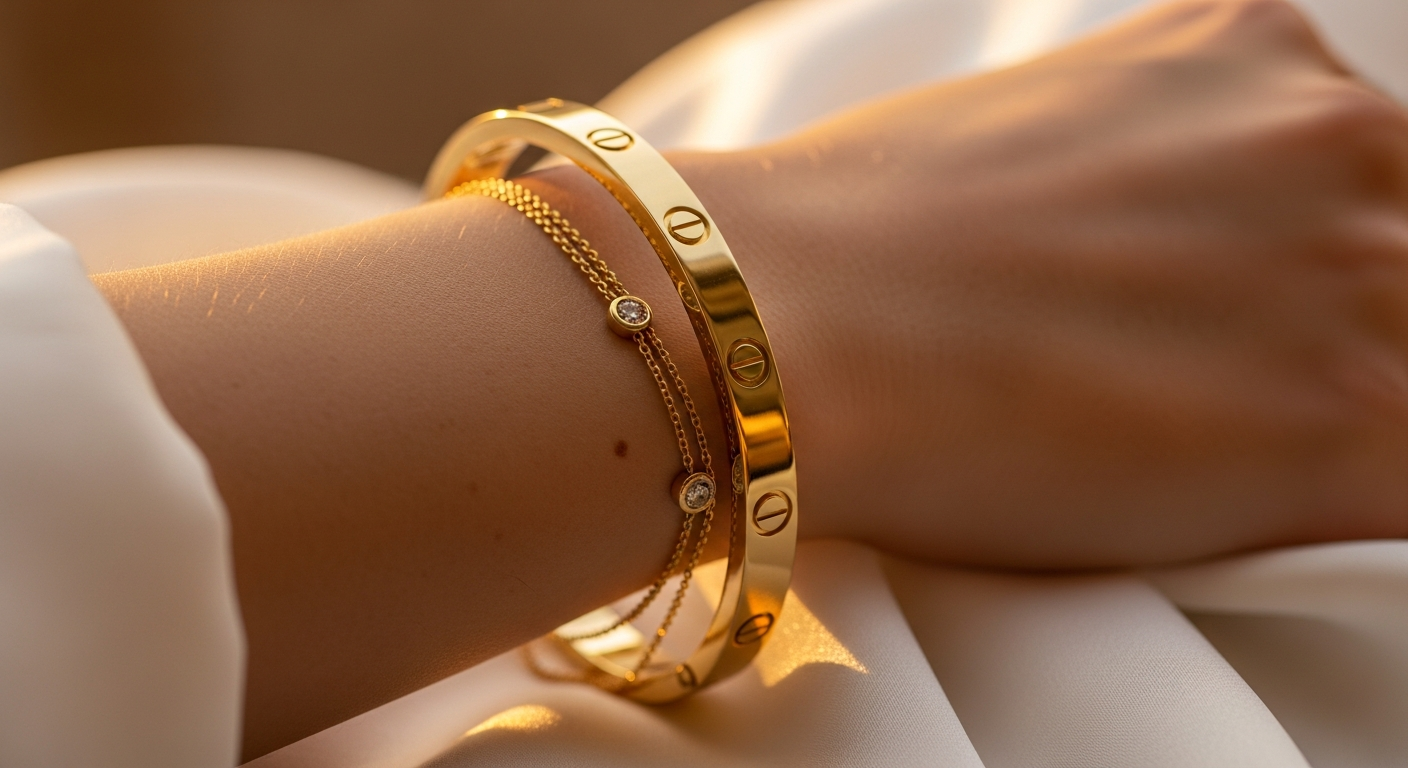
The Cartier Love Bracelet is one of the most recognizable pieces of jewelry ever created. Designed by Aldo Cipullo in 1969 for Cartier New York, its concept was radical: a bracelet that locks onto the wrist with a screwdriver, symbolizing a love that can't be easily removed. Nearly six decades later, it remains Cartier's best-selling piece — and one of the strongest performers on the secondary market.
But the Love Bracelet's resale market is also one of the most misunderstood. Not all versions hold value equally. Authentication is critical in a market flooded with counterfeits. And the gap between retail and resale has shifted dramatically as Cartier has raised prices aggressively. Here's what the data actually shows.
Current Resale Values by Configuration
The Love Bracelet comes in dozens of variations across metals, sizes, and diamond configurations. Resale performance varies significantly depending on what you buy.
Yellow Gold, Classic (no diamonds): The original and most iconic version. Retail price as of 2026: $7,800. Secondary market: $5,200–$6,800. This represents a 13–33% discount from retail, making pre-owned the smart buy. Yellow gold has surged in popularity with younger buyers, and resale values have tightened over the past 18 months.
Rose Gold, Classic: Same retail as yellow gold at $7,800. Secondary market: $5,000–$6,500. Rose gold saw a massive popularity spike in 2018-2021 but has cooled slightly, resulting in marginally lower resale values than yellow gold. Still holds well relative to most jewelry.
White Gold, Classic: Retail $7,800. Secondary market: $4,800–$6,200. White gold consistently underperforms yellow and rose on the secondary market. The visual similarity to stainless steel (which Cartier doesn't offer in the Love) works against it — buyers paying $5,000+ want the metal to be immediately recognizable.
Yellow Gold, 4 Diamonds: Retail $11,100. Secondary market: $7,500–$9,500. The four-diamond version commands a premium over the classic and actually retains a higher percentage of retail value. Diamond configurations signal authenticity more clearly, which supports resale prices.
Yellow Gold, Paved Diamonds: Retail $32,000+. Secondary market: $20,000–$28,000. Fully paved versions hold well in absolute dollars but the percentage discount from retail is larger. These are luxury purchases rather than value plays.
Platinum: Retail $11,500. Secondary market: $6,500–$8,500. Platinum Love Bracelets are rarer but the demand is lower. This makes them harder to sell but potentially a better value buy if you prefer the metal.
Authentication: How to Spot a Fake Love Bracelet
The Love Bracelet is one of the most counterfeited luxury items in the world. High-quality fakes have become sophisticated enough to fool casual inspection. Here's how to protect yourself.
Serial number placement and format: Every authentic Love Bracelet has a serial number engraved on the inner curve, along with the Cartier logo, metal stamp (750 for 18k gold), and size. Pre-2010 bracelets have a two-letter + five-number format. Post-2010 use a three-letter + five-number format. The engraving should be laser-sharp and perfectly aligned — fakes often show slightly uneven or too-deep engraving.
Screw mechanism: In 2011, Cartier redesigned the Love Bracelet from a screw system (screws removed completely) to a screw-in system (screws stay attached). Post-2011 bracelets with removable screws are definitively fake. This is one of the easiest authentication checks.
Weight: An authentic 18k yellow gold Love Bracelet in size 17 weighs approximately 32–35 grams. Fakes often use gold plating over base metal and weigh significantly less (22–28 grams) or use a denser alloy that feels slightly off. A jeweler's scale is your friend.
Hallmarks: Look for the French eagle head hallmark (for Cartier-made pieces), the 750 gold purity stamp, and the Cartier signature. Under magnification, authentic stamps are crisp and consistent. Counterfeits often have stamps that are slightly too large, too small, or poorly centered.
The screwdriver: Cartier's screwdriver has evolved over the years. Current versions are rose gold–colored with the Cartier logo. The quality of the screwdriver itself is a tell — counterfeits often include a screwdriver that's slightly too thick, too thin, or has a poorly reproduced logo.
Where to authenticate: Entrupy offers AI-powered authentication for Cartier jewelry. The Real Real and Rebag authenticate in-house. For high-value purchases, an independent appraisal from a GIA-certified gemologist ($75–$150) is worth every penny.
Where to Buy Below Retail
The secondary market for Love Bracelets is deep and liquid. Here are the best channels ranked by trust and value.
Certified pre-owned dealers: The RealReal, Rebag, Fashionphile, and Vestiaire Collective all carry authenticated Love Bracelets. Expect to pay 15–30% below retail with full authentication guarantees. Fashionphile consistently offers the best prices for Cartier jewelry, while The RealReal runs frequent promotions that can push discounts to 35%+.
Chrono24 Jewelry: Chrono24 has expanded beyond watches into fine jewelry. Their Trusted Checkout program provides buyer protection. Selection is growing, and you'll occasionally find deals from private sellers that undercut the major consignment platforms.
Direct from Cartier (pre-owned program): Cartier launched its own certified pre-owned program in select markets. Prices are only marginally below retail, but you get full Cartier authentication and a limited warranty. Worth considering if the small discount offsets your desire for boutique experience.
Private sales: eBay, forums, and social media marketplaces offer the lowest prices but the highest risk. Only buy privately if you're confident in your ability to authenticate, or budget for independent authentication before closing the deal.
The Investment Case for Cartier Jewelry
Let's be honest about what the Love Bracelet is and isn't from an investment perspective.
It's a strong store of value. A Love Bracelet purchased at retail today will likely be worth 65–85% of its retail price in five years. When you factor in Cartier's annual price increases (typically 5–8% per year), a bracelet bought today at $7,800 will have a retail replacement cost of $10,000+ by 2031. Your $5,500 resale value starts looking very reasonable against that rising floor.
Gold content provides a floor. A classic Love Bracelet contains approximately 32 grams of 18k gold. At current gold prices (~$2,400/oz for 24k, adjusted for 75% purity), the melt value is roughly $1,850. This creates an absolute floor that no counterfeit or fashion shift can break. As gold prices rise, this floor rises with them.
It's not a pure investment. Unlike a Rolex Daytona that can trade above retail, the Love Bracelet consistently trades below retail on the secondary market. You will not make money buying at retail and reselling. The value proposition is wearing a beautiful piece of jewelry that retains most of its value — not generating returns.
Vintage is where the appreciation lives. Pre-2000 Love Bracelets with the old screw system have developed a collector following. Early 1970s examples from Cipullo's era command significant premiums at auction. If you're buying with appreciation in mind, vintage is the play — but authentication becomes even more critical.
Buying Strategy: What LuxMetrix Recommends
Based on our data analysis, here's the optimal approach for buying a Love Bracelet in 2026:
Best value: Buy pre-owned, yellow gold, classic (no diamonds), size 17 or 19. These are the most liquid configurations with the best resale values relative to purchase price. Yellow gold is the iconic choice and commands the strongest secondary market demand.
Best long-term hold: Yellow gold with 4 diamonds. The diamond configuration retains a higher percentage of retail value and is easier to authenticate, which supports resale. The incremental cost over the classic version ($3,300 at retail) is partially preserved on resale.
Avoid for value: White gold without diamonds (lowest resale percentage), seasonal limited editions (novelty fades), and thin/small versions (SM model — lower gold content and lower demand).
Timing: The best secondary market deals appear in January (post-holiday selling) and September (pre-holiday consignment). If you can wait for these windows, you'll typically save an additional 5–10% over average secondary market prices.
Track Cartier on LuxMetrix
LuxMetrix is building the most transparent pricing intelligence platform for luxury assets. We currently track 16 luxury watch references with daily fair market values computed from real marketplace and auction data. Fine jewelry tracking — including Cartier Love, Cartier Juste un Clou, and Van Cleef & Arpels Alhambra — is coming in Q2 2026.
Become a Founding Member — the first 1,000 members receive complimentary Vault access for 12 months ($1,188 value). Be the first to access jewelry valuations when they launch.
LuxMetrix provides fair market value estimates based on publicly available data. These are not financial recommendations or appraisals. Always do your own research before making purchasing decisions.