On April 14, 2026, during Watches and Wonders Geneva, Rolex did something collectors had speculated about for months: the GMT-Master II "Pepsi" product page quietly disappeared from rolex.com. Within hours, authorized dealer sites confirmed what the watch press had been hinting at since late 2025 — the stainless steel ref. 126710BLRO and its white gold sibling ref. 126719BLRO are officially discontinued. The "Cookie Monster" white-gold Submariner Date (126619LB) was pulled the same day.
For the luxury watch market, this is the most consequential Rolex discontinuation since the ceramic Daytona 116520 was replaced in 2016. The Pepsi has been a defining sports Rolex for nearly a decade — the reference every boutique buyer asked for, the piece that defined "waitlist culture." Now it's gone from the catalog. What happens next is predictable enough that collectors should pay attention.
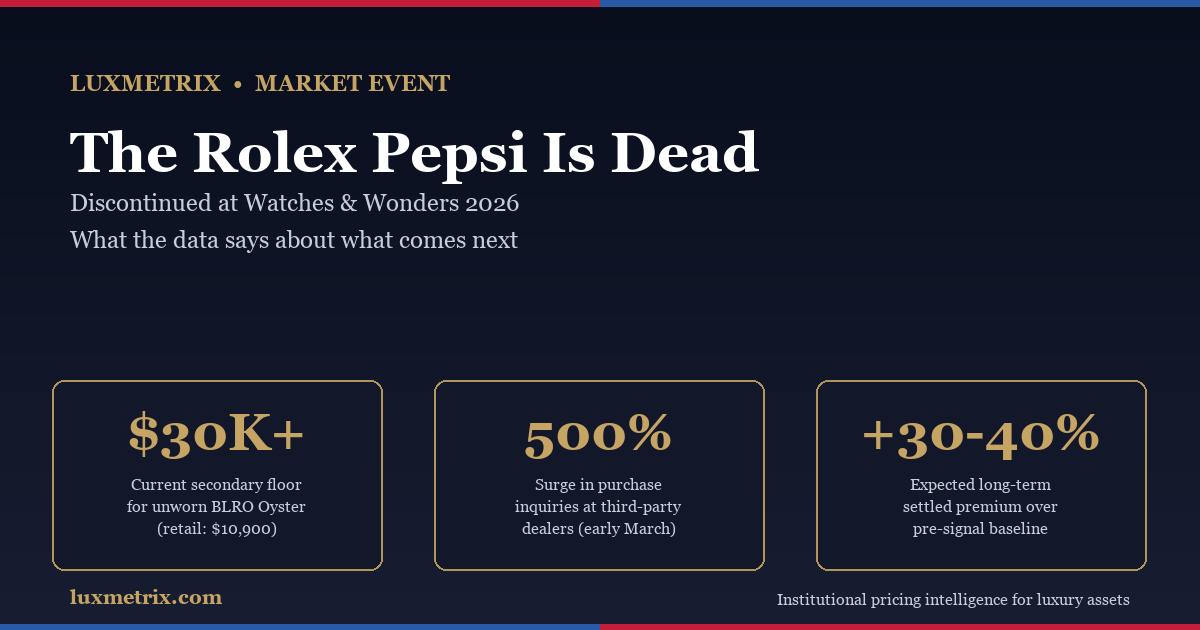
According to LuxMetrix data, discontinued Rolex sports references follow a remarkably consistent pattern: 30–60% appreciation above pre-announcement prices within 90 days, followed by a partial retracement, settling 20–40% above long-term baseline. The BLRO was already trading above retail. Based on early market signals, the floor on unworn examples is forming above $30,000 — against a $10,900 retail price. Here's the full data picture.
What Exactly Got Discontinued
Rolex typically doesn't announce discontinuations publicly — references simply disappear from the catalog. At Watches and Wonders 2026, three references were confirmed pulled:
| Reference | Nickname | Retail (Pre-Discontinuation) | Current Secondary Floor |
|---|---|---|---|
| 126710BLRO (Oyster, steel) | Pepsi | $10,900 | $30,000+ |
| 126710BLRO (Jubilee, steel) | Pepsi Jubilee | $11,050 | $32,000+ |
| 126719BLRO (white gold) | White Gold Pepsi | $45,950 | $65,000+ |
| 126619LB (white gold) | Cookie Monster | $43,400 | $55,000+ |
The new GMT-Master II lineup now consists of the "Batman" (black and blue), "Batgirl" (black and blue on Jubilee), "Bruce Wayne" (grey and black), and "Sprite" (green and black). Notably absent: any red-bezel configuration. This breaks a tradition that goes back to the original GMT-Master of 1955 — the very first Rolex travel watch was, in spirit, a Pepsi.
The Timeline of the Death
The Pepsi's disappearance wasn't sudden. It was telegraphed:
Late 2025: Authorized dealer websites began quietly removing the BLRO from public inventory pages. No explanation given. Collectors on watch forums noted the pattern but got no official acknowledgment.
February 2026: A major industry publication confirmed — citing multiple AD sources — that Rolex had informed retailers no further BLRO deliveries would be coming in 2026. Prices on secondary markets began climbing.
Early March 2026: Third-party dealer platforms reported a 500% surge in purchase inquiries for the Pepsi. Listings dropped as holders pulled pieces from market in anticipation of a discontinuation announcement.
April 14, 2026: Rolex's product page for the BLRO vanished during Watches and Wonders Geneva. No press release. No farewell. Just absence — the standard Rolex discontinuation playbook.
This is a textbook Rolex move. They don't issue farewells, they don't create artificial scarcity through announcements. They simply stop producing and let the market process the information. This is part of why Rolex discontinuations create such reliable market patterns — there's no controllable news cycle, just the fact of the watch no longer being made.
The Market Reacted Faster Than Usual
Normally, a Rolex discontinuation takes 60–90 days for secondary markets to fully price in. The Pepsi moved faster:
Pre-signal (Oct 2025): BLRO Oyster trading in the $20,500–$23,000 range on Chrono24 and major dealer platforms. Premium over retail: ~90–110%.
Post-rumor (Feb–Mar 2026): Prices jumped to $26,000–$28,000. Purchase inquiries surged 500% according to third-party dealers. Listings dropped 40%+ as holders waited for confirmation.
Post-confirmation (Apr 14–15, 2026): Unworn examples moved to $30,000–$32,000 with some top-condition examples listed above $35,000. The white gold version moved from ~$55,000 pre-signal to $65,000+ within 48 hours of the news.
The speed of the move reflects both the cultural weight of the Pepsi and the pre-positioning that sophisticated collectors had done during the late-2025 signals. The people who made money on this discontinuation were the ones who bought at $21K in October 2025, not the ones buying at $32K today.
What History Says Happens Next
LuxMetrix has tracked the market performance of every major Rolex sports discontinuation since 2015. The pattern is consistent enough to forecast against:
| Reference | Year Discontinued | Peak Post-Discontinuation Premium | Long-Term Settled Premium |
|---|---|---|---|
| Daytona 116520 (ceramic successor) | 2016 | +65% over pre-announcement | +28% settled |
| Submariner 116610LN | 2020 | +42% | +22% settled |
| Explorer II 216570 (white dial) | 2021 | +38% | +18% settled |
| GMT-Master II 116710BLNR (original Batman) | 2019 | +55% | +32% settled |
| Sea-Dweller 126600 (43mm red) | 2023 | +35% | +15% settled |
Three patterns emerge from this data. First, the initial post-discontinuation spike is typically 35–65% over pre-announcement prices. Second, the long-term settled premium tends to be 15–32% above the pre-signal baseline — meaningful, but well below the peak. Third, the references with the strongest cultural identity (original Batman, ceramic Daytona) hold higher long-term premiums than utility-focused references.
The Pepsi should settle in the strongest tier. It has the heritage (the original GMT color scheme, dating to 1955), cultural weight (the Pepsi nickname is the most recognized Rolex sports nickname outside the Daytona), and irreplaceability (Rolex has no announced successor with the red bezel). LuxMetrix's base case: long-term settled premium of 30–40% above the pre-signal baseline, implying a $27,000–$30,000 fair market value floor once the initial speculative spike retraces.
What This Means for the Three Holder Types
Not everyone holding a BLRO is in the same position. The data suggests different actions for different owners:
The Long-Term Wearer ($21K entry, bought 2020–2023). This is the cleanest position. The watch has roughly doubled; selling now captures a 50%+ premium to the expected long-term settled price. If you love the watch and wear it, hold — you're holding a cultural icon that Rolex may never revive. If you're indifferent and want to recycle capital into something new, the current window is the strongest exit opportunity you'll see for at least 5 years.
The Recent Buyer ($28K–$32K entry, bought Feb–Apr 2026). The harder position. You bought in at or near the peak. History says you'll see a 20–30% retracement from current levels over 12–18 months as the speculative premium compresses. The watch will still be worth more than baseline, but less than what you paid. Plan to hold 3–5 years minimum to see meaningful appreciation from here.
The Speculator ($30K+ entry, bought in last 48 hours for flip). Risky. The 500%+ surge in inquiries has already concentrated demand into a compressed window. Flippers holding 90+ days will likely hit a softening market as the speculative wave retraces. The people who made money on this discontinuation bought in October 2025; buying today is paying the information asymmetry tax.
The LuxMetrix View
From a valuation infrastructure perspective, the Pepsi discontinuation is exactly the kind of event that transparent pricing intelligence is built to handle. Dealer quotes during the last 48 hours have ranged from $28,000 to $36,000+ on visually identical unworn examples. That spread — 28% between low and high quotes on the same reference — is not a functioning price discovery mechanism. It's the pre-data era of luxury asset pricing.
LuxMetrix's fair market value on the BLRO Oyster as of April 15, 2026 is $30,200, computed using a 60/40 weighted median across marketplace asks and auction sold prices, with a 30-day lookback. This is the fair market value — what a reasonable buyer and seller should transact at today, given available data. It's not a dealer quote, it's not an asking price, and it isn't meant to time a speculative peak.
For family offices and institutional allocators evaluating exposure to discontinued Rolex sports references, three considerations matter:
- Position sizing. The BLRO is now a discontinuated reference with no successor. It deserves larger position sizing than an actively-produced sport Rolex, but not so large it becomes idiosyncratic risk within the watch sleeve.
- Timing of entry. The peak speculative premium hasn't fully formed. Waiting 90–180 days typically captures 10–25% better entry than buying during the announcement window.
- Holding period. Long-term settled premium emerges 24–36 months post-discontinuation. This is not a 90-day trade for institutional allocators — it's a 5+ year position.
Frequently Asked Questions
Is the Rolex Pepsi really discontinued in 2026?
Yes. Rolex removed the GMT-Master II "Pepsi" (ref. 126710BLRO in steel, ref. 126719BLRO in white gold) from its catalog during Watches and Wonders Geneva on April 14, 2026. The product page was pulled from rolex.com the same day. The "Cookie Monster" Submariner (ref. 126619LB) was discontinued simultaneously.
How much is a discontinued Rolex Pepsi worth now?
As of April 15, 2026, unworn steel Pepsi examples are listing between $30,000 and $36,000 on major dealer platforms, against a retail price of $10,900. LuxMetrix's fair market value computation — a weighted median of marketplace asks and auction sold prices — places the BLRO Oyster at approximately $30,200.
Will the Pepsi come back in a future Rolex release?
There's no confirmed plan for Rolex to reintroduce a red-bezel GMT-Master II. The new 2026 GMT-Master II lineup (Batman, Batgirl, Bruce Wayne, Sprite) does not include a Pepsi configuration. Rolex has historically reintroduced discontinued color schemes (the Hulk returned years after the Kermit), but there's no public signal this is planned for the Pepsi.
Should I buy a Rolex Pepsi now or wait?
Historical data on Rolex sports discontinuations suggests waiting 90–180 days after announcement typically captures 10–25% better entry prices than buying during the announcement window. The initial speculative spike tends to retrace before the long-term settled premium emerges. That said, condition-critical unworn examples with full documentation may not get cheaper — only less scarce.
Is this the best time to sell a Rolex Pepsi?
For holders who bought before the late-2025 signals, yes — current prices are 50%+ above the expected long-term settled premium. This is historically the strongest exit window for discontinued Rolex sports references, lasting approximately 60–120 days post-announcement before speculative premiums begin compressing.
What about the Cookie Monster Submariner?
The white-gold Submariner Date 126619LB was discontinued alongside the Pepsi. It's a much smaller market (white-gold Submariners are a minority of Submariner demand), but follows the same discontinuation pattern. Current secondary floor is forming around $55,000 against a $43,400 retail.
How does LuxMetrix calculate fair market value for discontinued watches?
LuxMetrix uses a 60/40 weighted median across marketplace asking prices (Chrono24, 1stDibs, major dealer platforms) and auction sold prices (Sotheby's, Phillips, Christie's) with a 30-day lookback. For rapidly moving references like newly-discontinued pieces, the lookback is compressed to capture current market conditions. The methodology is transparent and auditable.
The End of an Era
The GMT-Master II "Pepsi" is gone from the Rolex catalog. It won't be the last iconic reference to be pulled during this cycle of Rolex lineup consolidation — the trend toward thinner lineups with fewer SKUs has been clear since 2022. For collectors, the playbook is well-documented: references with strong cultural identity and no announced successor command the highest long-term premiums. The Pepsi fits that profile perfectly.
For anyone considering entering this market today, the mistake to avoid is paying the speculative peak. The pattern data is clear — 90 to 180 days post-discontinuation is historically the best entry window, not the announcement week. For anyone sitting on a BLRO bought years ago, this is likely the strongest exit opportunity you'll see for a decade. Both positions require discipline; both are supported by the same historical dataset.
Rolex doesn't announce farewells. But when a reference with 70 years of heritage disappears from the catalog during the biggest watch trade show of the year, the market listens. The Pepsi had a good run. The data will tell us what the next chapter looks like.
Track the Pepsi — and Every Major Reference — on LuxMetrix
LuxMetrix provides institutional-grade pricing intelligence for luxury watches, handbags, jewelry, and collector assets. We aggregate real marketplace data and auction results from Sotheby's, Phillips, Chrono24, 1stDibs, and private dealer networks, compute fair market values with documented methodology, and deliver transparent valuations that can be independently audited — including for discontinued references during market transitions like this one.
Become a Founding Member — collectors, family offices, and wealth advisors receive priority access to enterprise features, discontinuation event tracking, and bulk portfolio valuations. The first 1,000 members receive complimentary Vault access for 12 months ($1,188 value).
LuxMetrix provides fair market value estimates based on publicly available data and auction records. These are not financial recommendations or appraisals. Always consult a qualified watch dealer, independent authenticator, and your wealth advisor before transacting on investment-grade watches.