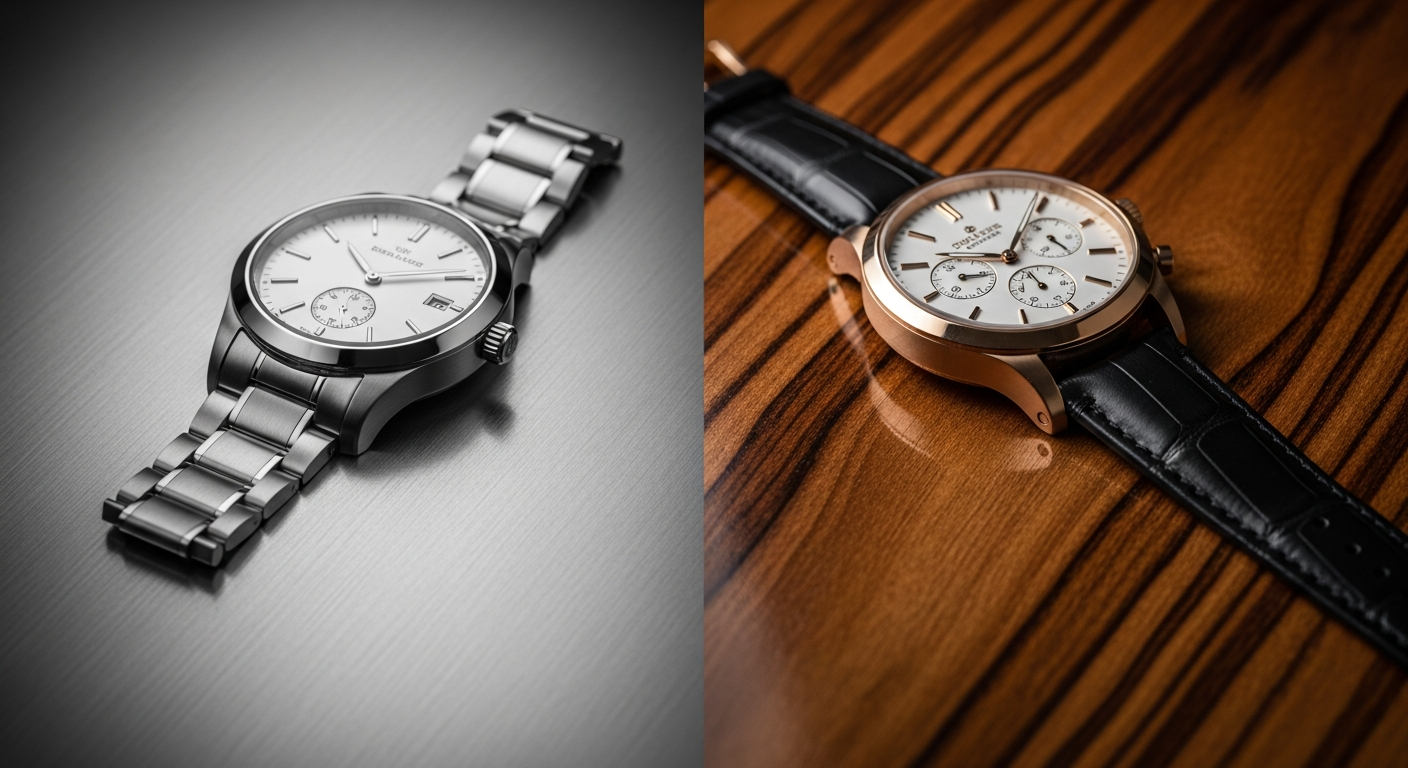
It’s the question that divides every watch collector dinner table, every Reddit thread, every dealer back room: Rolex or Patek Philippe?
Both brands sit at the apex of Swiss watchmaking. Both command secondary market premiums that would make most luxury goods manufacturers blush. But when you strip away the brand loyalty, the heritage arguments, and the Instagram hype — which one actually holds its value better?
At LuxMetrix, we don’t do opinions. We track real pricing data from Chrono24 marketplace listings and auction results at Phillips and Sotheby’s. Here’s what the numbers say.
The Brands at a Glance
Before we dive into the data, let’s acknowledge what makes each brand distinct — because understanding their positioning explains a lot about their resale behavior.
Rolex produces an estimated 800,000 to 1,000,000 watches per year. They’re the largest luxury watch manufacturer in the world, and their marketing machine is unrivaled. A Rolex is recognizable from across a room. It’s the watch you buy to signal success, and the watch you keep because it works flawlessly for decades.
Patek Philippe produces roughly 60,000 to 70,000 watches per year — less than one-tenth of Rolex’s output. They position themselves as the pinnacle of haute horlogerie, with hand-finished movements and complications that Rolex doesn’t attempt. The famous tagline — “You never actually own a Patek Philippe, you merely look after it for the next generation” — isn’t just marketing. It’s a resale strategy disguised as philosophy.
Head-to-Head: The Data
Let’s compare the flagships. These are the references that define each brand on the secondary market.
Rolex Daytona 116500LN
- Fair Market Value: $31,721
- Retail Price: $15,100
- Premium Over Retail: 110%
- Comp Count: 64
- Confidence Score: 71/100 (High)
Patek Philippe Nautilus 5711/1A
- Fair Market Value: $131,560
- Retail Price: ~$35,000 (when available)
- Premium Over Retail: 276%
- Comp Count: 8
- Confidence Score: 46/100 (Medium)
On raw premium alone, Patek wins decisively. The Nautilus trades at nearly 4x its retail price versus the Daytona at 2x. But premium over retail doesn’t tell the whole story — because you can’t buy either at retail. The real question is: if you buy on the secondary market today, what happens to your money?
Liquidity: Rolex Dominates
This is where Rolex pulls ahead, and it’s not close.
The Daytona 116500LN has 64 comparable data points in our system across multiple sources. At any given moment, there are 50–80 active listings on Chrono24 alone. If you need to sell a Daytona, you can have cash in hand within a week. Often within days.
The Nautilus 5711/1A has 8 comparable data points. It’s a thinner market — fewer sellers, fewer buyers, wider spreads between asking and transaction prices. If you need to sell quickly, you may have to accept a discount from the theoretical fair value.
What this means for investors: Rolex offers superior liquidity. You can enter and exit positions faster with less slippage. This matters if you’re treating watches as a liquid store of value rather than a long-term hold.
Volatility: Patek Swings Harder
The 2021–2022 speculative bubble hit both brands, but it hit Patek harder.
At peak, the Nautilus 5711/1A traded above $200,000 on the secondary market. It’s now around $131,000 — a decline of roughly 35% from the top. That’s painful if you bought at the peak.
The Daytona peaked around $45,000–$50,000 and has settled to approximately $32,000 — a decline of roughly 30%. Still significant, but the absolute dollar loss is far smaller, and the floor feels more established given the deeper liquidity.
The pattern: Patek’s lower production volume creates sharper price movements in both directions. When demand surges, prices spike dramatically. When sentiment cools, the thin market amplifies the decline. Rolex’s larger production and deeper secondary market creates more price stability — less explosive upside, but a more predictable floor.
The Full Roster Comparison
It’s not just about the flagships. Let’s look at how the broader lineup performs.
Rolex References We Track
| Reference | Fair Value | Comps | Confidence |
|---|---|---|---|
| Daytona 116500LN | $31,721 | 64 | High |
| GMT Pepsi 126710BLRO | $26,172 | 20 | High |
| GMT Batman 126710BLNR | $20,516 | 36 | High |
| Day-Date 228238 | $58,980 | 45 | Medium |
| Submariner 126610LN | $18,135 | 28 | High |
| Datejust 41 126334 | $13,495 | 35 | High |
| Submariner No-Date 124060 | $11,930 | 16 | Medium |
| Explorer 124270 | $9,444 | 16 | Medium |
The strength of Rolex is breadth. Every sport reference holds a premium. The entry points are lower — you can get into a Submariner for under $15,000 or an Explorer for under $10,000 — and the confidence scores are consistently high because of deep market data.
Patek Philippe References We Track
| Reference | Fair Value | Comps | Confidence |
|---|---|---|---|
| Nautilus 5711/1A | $131,560 | 8 | Medium |
| Aquanaut 5167A | $84,272 | 17 | Medium |
Patek’s numbers are bigger, but the confidence is lower. Fewer comps means wider uncertainty bands around the fair value estimate. This isn’t a flaw in our methodology — it’s a feature of the market. There simply aren’t as many Pateks changing hands.
Depreciation Resistance
Here’s where it gets nuanced. Different Rolex references behave very differently:
Near-zero depreciation: The Submariner 126610LN trades close to retail. You can wear it for years and sell it for roughly what you paid. This is Rolex’s sweet spot — the workhorse that acts as a store of value without requiring a huge premium investment.
Premium appreciation: The Daytona and GMT models trade well above retail, but they’ve settled from their 2022 highs. If you bought at the bottom of the correction, you’re looking good. If you bought at the top, you’re underwater.
Patek’s thesis is different: You don’t buy Patek for near-term appreciation. You buy because discontinued Patek references have a 50-year track record of appreciating as supply permanently contracts. The 5711/1A was discontinued in 2021. Every year, fewer become available as collectors absorb them into long-term holdings. The math is simple: fixed demand, shrinking supply, rising prices. But the timeline is measured in decades, not quarters.
The Brand Recognition Factor
There’s an intangible that doesn’t show up in spreadsheets but absolutely affects resale: recognition.
Ask anyone on the street to name a luxury watch brand. Nine out of ten will say Rolex. Maybe one will say Patek Philippe. This matters because the broader the recognition, the broader the buyer pool. When you sell a Rolex, you’re selling to collectors, enthusiasts, first-time buyers, gift shoppers, and people who just got a bonus and want something nice. That’s a massive demand base.
When you sell a Patek, you’re selling almost exclusively to serious collectors and ultra-high-net-worth individuals who already know what they’re looking at. It’s a smaller pool, but those buyers are less price-sensitive and more committed to holding.
This dynamic creates an interesting paradox: Rolex is easier to sell but trades at lower multiples. Patek is harder to sell but commands astronomical premiums when you find the right buyer. It’s the difference between selling a house in a popular suburb versus a penthouse in Monaco — different markets, different timelines, different outcomes.
The Servicing Question
One factor that many first-time buyers overlook is servicing costs and their impact on long-term value retention.
A Rolex service runs approximately $800–$1,200 at an authorized service center, with intervals recommended every 10 years. The movements are robust, modular, and designed for longevity. Third-party watchmakers can service most Rolex movements competently, giving you pricing flexibility.
A Patek Philippe service can cost $2,000–$5,000 depending on the complication, and Patek strongly recommends servicing exclusively through their own service centers. Their movements are more delicate and hand-finished to a degree that requires specialized expertise. However, Patek will service any watch they’ve ever made — a promise that extends back to 1839. That lifetime commitment to their product is part of what justifies the premium.
For investment purposes, a properly serviced watch with service records from the manufacturer commands a meaningful premium over one without. This is true for both brands, but the cost of maintaining that documentation trail is significantly higher with Patek.
Who Should Buy What
This isn’t a one-size-fits-all answer. Your choice depends on what you’re optimizing for.
Buy Rolex if you want:
- High liquidity — fast in, fast out
- Lower entry points ($8,000 – $60,000 range)
- Price stability with moderate upside
- A watch you can wear daily without worry
- Strong data confidence in valuations
Buy Patek Philippe if you want:
- Maximum long-term appreciation potential
- Prestige and exclusivity within the collector community
- A generational asset that you pass down
- Exposure to the ultra-luxury segment
- You can afford the entry price and don’t need liquidity
Buy both if you can. The smartest collectors diversify across brands just like they diversify across asset classes. A Submariner for daily wear, a Nautilus for the vault.
The Verdict
If we have to pick one — Rolex holds its value more reliably. The data is clear: higher liquidity, tighter spreads, deeper market confidence, and lower volatility. For most buyers, a Rolex sport reference is the safer bet.
But Patek Philippe has higher upside for patient holders. If you can afford the entry price, don’t need liquidity, and can hold for 10–20 years, discontinued Patek references have historically outperformed everything else in the watch market.
The real answer? It depends on whether you’re building a liquid portfolio or a generational collection. Rolex is the blue-chip stock. Patek is the real estate — less liquid, higher maintenance, but potentially transformative returns over a long enough timeline.
How We Calculated This
Every number in this article comes from the LuxMetrix valuation engine:
- Real marketplace data scraped daily from Chrono24
- Auction results from Phillips and Sotheby’s
- Fair values computed as 60% auction sold median + 40% marketplace ask median
- Confidence scores based on data volume, source diversity, recency, and price spread
We don’t take advertising money from either brand. We don’t sell watches. We just track the data.
Track Both Brands for Free
LuxMetrix tracks Rolex, Patek Philippe, Audemars Piguet, Omega, Cartier, Tudor, and IWC — 16 references and counting. Daily price updates, fair market valuations, and buy/hold/sell signals. Completely free.
Become a Founding Member — complimentary Vault access for the first 1,000 members.
LuxMetrix provides fair market value estimates based on publicly available data. These are not financial recommendations or appraisals. Always do your own research before making purchase decisions.