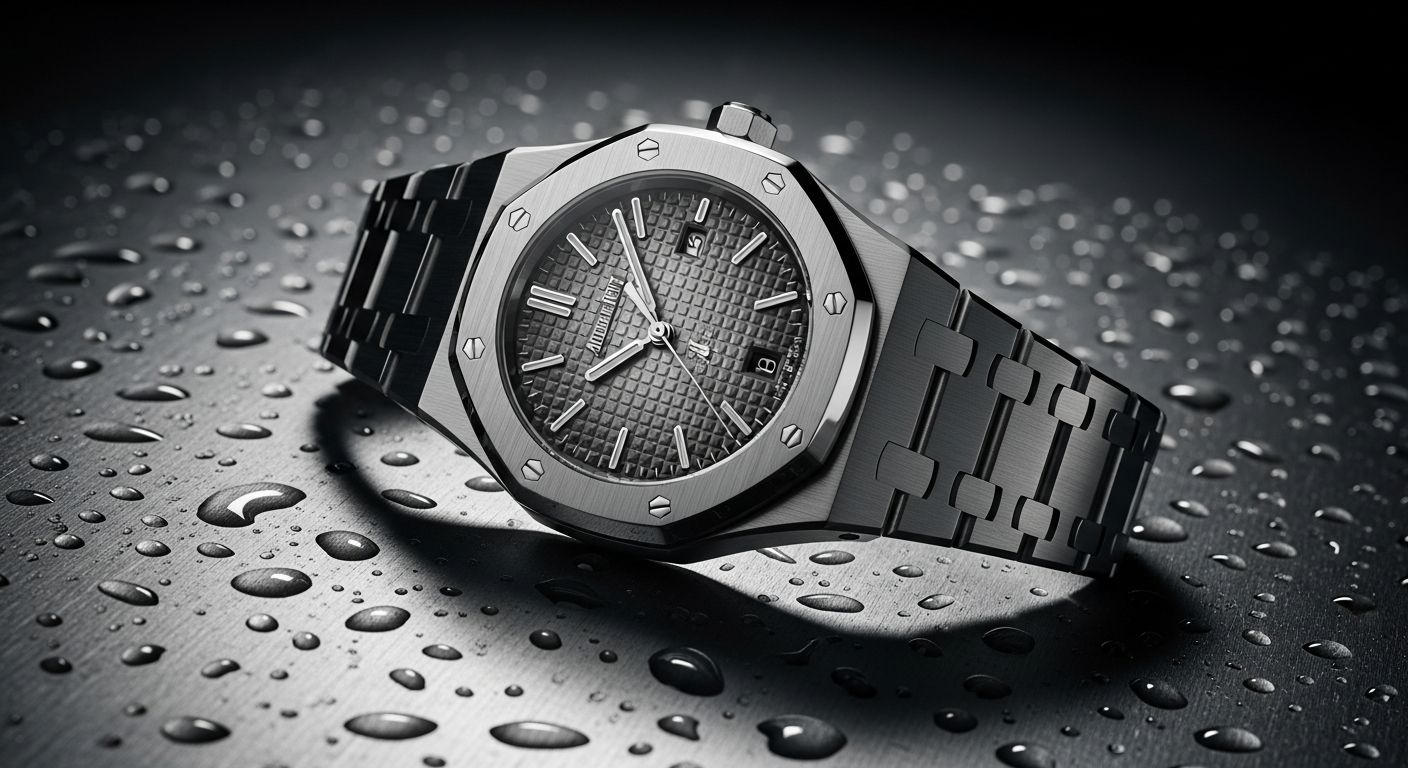
In 1972, a watch brand best known for complicated dress watches did something nobody expected. Audemars Piguet commissioned Gerald Genta — the most celebrated watch designer of the 20th century — to create a luxury sports watch in stainless steel. The result was the Royal Oak, and it nearly destroyed the company.
Retailers refused to stock it. A steel watch at a gold watch price? Collectors were confused. Critics were brutal. But AP held the line, and within a few years the Royal Oak became one of the most important watches ever made. Today it's the cornerstone of a brand valued in the billions, and the secondary market for Royal Oaks has become one of the most interesting spaces in luxury watches.
At LuxMetrix, we track the Royal Oak 15500ST daily across multiple verified sources. Here's what the data tells us about where this watch has been, where it is now, and what it means for collectors in 2026.
The 15500ST: The Modern Reference
Current Fair Market Value: ~$44,355
The 15500ST is the current-generation 41mm Royal Oak in stainless steel with a blue dial — the configuration most collectors want. It replaced the beloved 15400ST in 2019, bringing an updated movement (calibre 4302) and subtle aesthetic refinements while maintaining the DNA that Gerald Genta established over fifty years ago.
At retail, the 15500ST lists for approximately $29,900. On the secondary market, it trades at roughly $44,355 — a 48% premium over retail. That premium has compressed significantly from the 2022 peak when examples were selling for $55,000-$60,000, but it has stabilized over the past twelve months into a range that appears sustainable.
Key Data Point: With 136 comparable data points across our verified sources, the Royal Oak 15500ST has one of the deepest liquidity pools in our index — meaning you can buy or sell with confidence that the price reflects genuine market consensus, not a thin market anomaly.
Price History: The Bubble and the Floor
The Royal Oak's secondary market journey over the past five years tells a story that's remarkably consistent with the broader luxury watch market, but with some AP-specific nuances worth understanding.
2019-2020: The 15500ST launched at a modest premium over retail — roughly $35,000-$38,000 on the secondary market. Demand was strong but not frenzied. AP's allocation system kept supply constrained, but the premiums were rational.
2021: Everything changed. A confluence of stimulus money, crypto wealth, social media hype, and genuine supply constraints pushed Royal Oak prices into territory nobody anticipated. The 15500ST hit $55,000-$60,000 by late 2021, representing a near-100% premium over retail. Every Instagram influencer suddenly needed a Royal Oak on their wrist.
2022: The correction hit hard. As interest rates rose and speculative money left the market, Royal Oak prices dropped 25-30% from peak within six months. Panic sellers took losses. Forums were full of regret. Headlines declared the luxury watch bubble had burst.
2023-2024: Stabilization. The 15500ST settled into the $42,000-$48,000 range and stayed there. The speculative froth disappeared, replaced by genuine collector demand. Transaction volumes remained healthy — people were buying and selling at these levels, not just holding and hoping.
2025-2026: The current market shows a Royal Oak that has found its equilibrium. At $44,355, the premium over retail is meaningful but not excessive. More importantly, the price is supported by deep liquidity — 136 data points across multiple sources tells us this isn't a fragile market.
What's Driving Royal Oak Prices in 2026
Several factors are keeping the Royal Oak market healthy despite the broader post-bubble hangover:
Supply control: Audemars Piguet produces approximately 60,000 watches per year — roughly a quarter of Rolex's output. The Royal Oak in steel configurations represents a fraction of that. AP has shown no interest in flooding the market, and unlike Rolex, they've maintained strict allocation policies without any signs of loosening.
Brand trajectory: AP has been on an upward brand trajectory for the past decade. The celebrity endorsement strategy (LeBron James, Serena Williams, Jay-Z) has expanded awareness without cheapening the brand. Unlike some competitors who've chased volume, AP has stayed disciplined.
The younger collector: The Royal Oak has become the aspirational watch for collectors in their 30s and 40s — a demographic that views it as a peer to the Nautilus rather than a step below. This generation treats the Royal Oak as a grail piece, not a consolation prize.
Limited alternatives: If you want a luxury steel sports watch with an integrated bracelet from a top-tier manufacture, your options are narrow. The Nautilus 5711/1A is discontinued and trades at $132,500. The Vacheron Constantin Overseas is less liquid. The Royal Oak sits in a sweet spot of prestige, design, and relative attainability that few competitors can match.
Which Royal Oak References to Watch
The 15500ST blue dial is the volume reference, but it's not the only Royal Oak worth tracking:
15500ST.OO.1220ST.01 (Blue dial): The benchmark. Deepest market, most liquid, most data. This is where our index focuses and where most collectors start. Fair value: ~$44,355.
15500ST.OO.1220ST.03 (Black dial): Trades at a slight discount to the blue dial — typically 5-8% less. Some collectors prefer the black for its versatility and subtlety. A genuinely undervalued option if you believe dial color premiums are irrational.
15500ST.OO.1220ST.04 (Grey dial): The newest dial variant and increasingly popular. Currently trading near parity with the blue, but lower production numbers could create a premium over time.
15202ST (Extra-Thin "Jumbo"): The purist's choice. 39mm case, calibre 2121 (soon to be replaced), and the closest to Genta's original design. Discontinued references with the 2121 movement are already appreciating. If you can find one, this is the Royal Oak that serious collectors covet.
26240ST (Royal Oak Chronograph): AP's updated chronograph with the flyback calibre 4401. Less liquid than the time-only models but gaining collector attention. Worth watching as a potential value play.
Royal Oak vs. The Competition
How does the Royal Oak stack up against its direct competitors on a pure value basis?
vs. Patek Philippe Nautilus 5711/1A ($132,500): The Nautilus trades at 3x the Royal Oak's price. Is it 3x the watch? Objectively, no. Both are luxury steel sports watches with integrated bracelets from prestigious manufactures. The Nautilus commands a scarcity premium driven by discontinuation and lower production. For collectors who want the look and the prestige without the $130K entry fee, the Royal Oak is the rational choice.
vs. Rolex Daytona 116500LN ($31,477): Different category — the Daytona is a chronograph and a Rolex, which means different buyer motivations. The Daytona is more liquid (more transactions per day) and lower-priced, but the Royal Oak has higher prestige in serious collector circles. It depends on whether you're optimizing for liquidity or cachet.
vs. Vacheron Constantin Overseas 4500V ($28,000-$35,000): The Overseas is arguably undervalued relative to the Royal Oak. Same tier of manufacture, arguably superior finishing, but significantly less market demand and brand heat. If you're buying purely on watchmaking merit, the Overseas is a sleeper. If you're buying for market dynamics and resale confidence, the Royal Oak wins.
Buying Guide: What to Look For
If you're considering a Royal Oak 15500ST, here's what matters:
Condition of the bracelet: The integrated bracelet is the Royal Oak's defining feature and also its most vulnerable component. Scratches on the flat, polished surfaces of the bracelet links are highly visible and expensive to refinish properly. Inspect bracelet condition carefully — it's the single biggest factor in pricing beyond basic functionality.
Box, papers, AP certificate: Full set examples command a 10-15% premium over watch-only sales. AP's warranty card includes purchase date and retailer, which helps verify provenance and confirms the watch isn't stolen or service-swapped.
Service history: The calibre 4302 is robust but not immune to wear. AP's official service costs $1,500-$2,500 and should be performed every 5-8 years. Ask for service records, and budget for a service if the watch hasn't been maintained.
Dial condition: The grande tapisserie (waffle) dial is one of the most recognizable textures in watchmaking. Check for discoloration, moisture damage, or any signs of refinishing. An original, clean dial is essential for value retention.
Where to buy: The same platforms that work for Rolex work here — established online marketplaces with buyer protection, reputable pre-owned dealers, and auction houses for rare references. Avoid private sales unless you can verify independently. AP fakes exist and are getting better.
The Investment Case
Is the Royal Oak a good investment in 2026? Here's the honest assessment:
Bull case: AP's production discipline shows no signs of weakening. The Royal Oak's cultural relevance is growing, not fading. The current price represents a 25-30% correction from peak — historically, buying luxury watches after a significant correction has been rewarded. And with 136 comps showing tight pricing consensus, the market is telling you this level is supported.
Bear case: The $44,355 price still represents a 48% premium over retail. If AP decided to increase production or make Royal Oaks more available at retail, that premium would compress. Additionally, the general economic environment — high interest rates, potential recession — could pressure discretionary luxury spending and push prices lower.
Our view: The Royal Oak 15500ST at current levels is a reasonable hold for existing owners and a cautious buy for new collectors. The risk-reward is more balanced than it was at $55,000, but it's not the screaming value that some references in the $10,000-$15,000 range offer. If you're buying because you love the watch and plan to wear it for five years, the data supports that decision. If you're buying purely as a financial trade, there may be better opportunities in the index.
Track the Royal Oak in Real Time
The Royal Oak market moves. New auction results, shifting dealer inventory, and seasonal demand patterns all influence pricing. LuxMetrix tracks the 15500ST across four verified sources with 136 data points — giving you the most transparent view of fair market value available anywhere.
Become a Founding Member — the first 1,000 members receive complimentary Vault access for 12 months ($1,188 value). Track the Royal Oak alongside 15 other luxury references in real time. Get buy/hold/sell signals. Know the real number before you buy or sell.
LuxMetrix provides fair market value estimates based on publicly available data. These are not financial recommendations or appraisals. Always do your own research before making investment decisions.