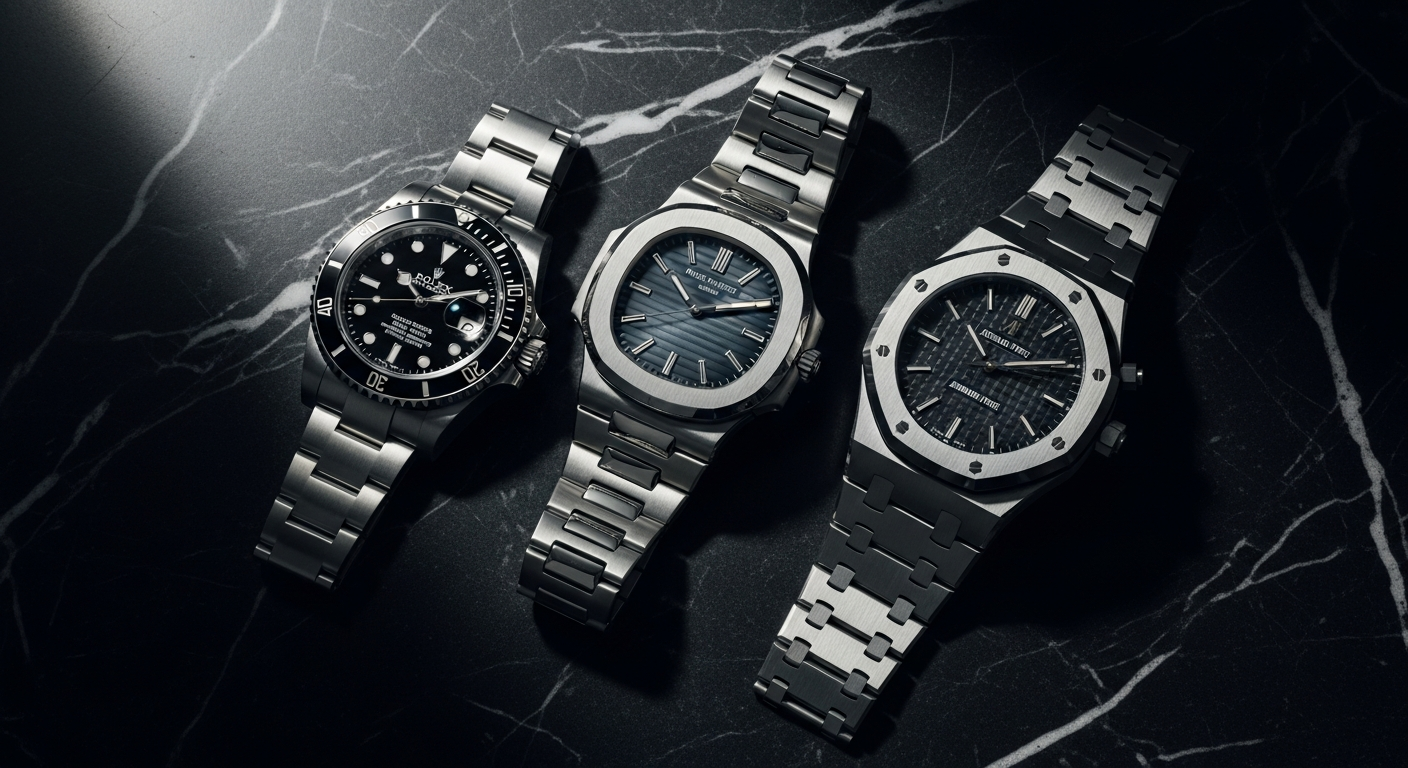
A luxury watch is worth what the market will actually pay for it today — not its retail price, not what a dealer quotes, and not what it sold for at the 2022 peak. As of July 2026, the LuxMetrix Luxury Watch Index — the combined fair market value of 18 blue-chip references — stands at $581,585, and individual references like the Rolex Daytona 116500LN carry a fair value near $31,291. Valuing a watch means triangulating three signals: recent auction results (what buyers actually paid), live marketplace listings (what sellers are asking), and the specific condition, completeness, and provenance of the individual watch. This guide explains how each factor moves value, how a professional valuation is calculated, and how to estimate what any reference is worth using real transaction data rather than guesswork.
What does it mean to value a luxury watch?
Valuing a luxury watch means estimating its fair market value — the price a willing buyer and a willing seller would agree on in an open market, for that specific watch, right now. It is a different number from three figures people often confuse it with:
- Retail price (MSRP) — what an authorized dealer charges new. For hyped references like the Patek Philippe Nautilus, the secondary market trades far above retail; for many dress watches, below it.
- Insurance / replacement value — what it would cost to replace the watch, usually set higher than market to cover retail markup.
- Dealer buy price — what a shop will pay you today, typically 10–20% under fair market value to leave room for their margin.
Fair market value sits in the middle: above the dealer buy price, below the insurance figure, and anchored to what comparable watches have actually changed hands for.
What determines a luxury watch's resale value?
Six factors move a watch's value more than any others:
- Reference desirability — the specific model and reference number, not just the brand. A Rolex GMT-Master II "Pepsi" and a Rolex Datejust are both Rolexes with very different demand curves.
- Production status — discontinued references with strong demand appreciate as supply permanently contracts. When Patek discontinued the steel Nautilus 5711/1A in 2021, prices climbed.
- Condition — unpolished cases, sharp lugs, and original dials command premiums; heavy wear and service dials discount value.
- Completeness (box & papers) — a "full set" with original box, warranty card, and accessories sells for more than a watch head alone.
- Provenance — documented ownership, service history, or a notable prior owner can add meaningfully at the high end.
- Liquidity — how many examples trade. Deep, liquid references (the Daytona, the Submariner) have tight, reliable pricing; thinly traded pieces swing more.
Auction price vs. retail vs. grey market — which is the real value?
Each price signal tells you something different. The most reliable anchor is the auction sold price, because it records money that actually changed hands rather than an asking price that may never be met.
| Price type | What it is | Relative level | Best used as |
|---|---|---|---|
| Retail (MSRP) | Authorized-dealer list price, new | Below market for hyped refs | A baseline, not a market value |
| Grey-market ask | Dealer / marketplace asking price | Above realized prices | An upper bound / ceiling |
| Auction sold | Hammer price plus buyer's premium, realized | The truest "paid" figure | The core fair-value anchor |
| LuxMetrix fair value | Weighted blend of sold + ask | Between ask and sold | The number to transact around |
Asking prices run high because sellers start optimistic and negotiate down. That is why LuxMetrix weights realized auction results more heavily than open listings when computing fair value.
How does LuxMetrix calculate fair market value?
LuxMetrix computes each reference's fair value as a 60/40 weighted blend of auction sold prices and marketplace asking prices. Sold prices carry the heavier weight because they reflect completed transactions. The pipeline removes statistical outliers using inter-quartile-range (IQR) filtering, normalizes every price to USD, and attaches a confidence score based on how many comparable sales exist, how many independent sources agree, and how tight the price spread is.
The result is a single fair value plus a realistic range. The Daytona 116500LN, for example, draws on 153 data points across Chrono24, Phillips, and Sotheby's for a July 2026 fair value near $31,291 — a "high confidence" reading. You can read the full valuation methodology and see every current reference in the Luxury Watch Index.
How much do box and papers add to a watch's value?
A complete "full set" — original box, warranty card (papers), booklets, and any accessories — typically adds 5–15% over the value of the watch head alone, and more on collectible or high-value references where authenticity and originality are scrutinized. Papers matter most when they confirm the production date and authorized-dealer provenance; on a $150,000 grail watch, missing papers can cost more than the entire value of an entry-level Tudor. On a modern, high-liquidity Rolex, the premium is smaller but still real, because buyers expect a full set at that price point.
How do you estimate what a specific reference is worth?
To value a specific watch yourself, work the same way a data-driven valuation does:
- Identify the exact reference — brand, model, and reference number (e.g., Rolex Cosmograph Daytona 116500LN), plus dial variant.
- Gather recent sold prices — the last few months of auction results and completed sales for that reference.
- Check live asking prices — current marketplace listings to see the ceiling.
- Filter outliers — ignore a single anomalous sale in either direction.
- Weight the realized prices — lean on what was actually paid, then adjust for your watch's condition and completeness.
Or skip the legwork: LuxMetrix already does this daily for every tracked reference. Browse the full watch value index, or jump straight to individual pages like the Daytona 116500LN to see the current fair value, range, and the comparable sales behind it.
Frequently asked questions
How do I find out what my watch is worth? Look up its exact reference number and compare recent auction results and current marketplace listings, weighting realized sales most heavily — or check the reference directly in the LuxMetrix index, which computes this from real data daily.
Is retail price the same as a watch's value? No. Retail is the new-from-dealer list price. Secondary-market value can be far above retail for hyped references or below it for others; the two are frequently different numbers.
Do box and papers really matter? Yes — a full set typically adds 5–15% and more on high-value or collectible references, because completeness supports authenticity and provenance.
Are luxury watches a good investment? Some blue-chip references have held or grown value, especially discontinued models with deep demand, but watches carry costs and liquidity risk. Track real values rather than relying on hype.